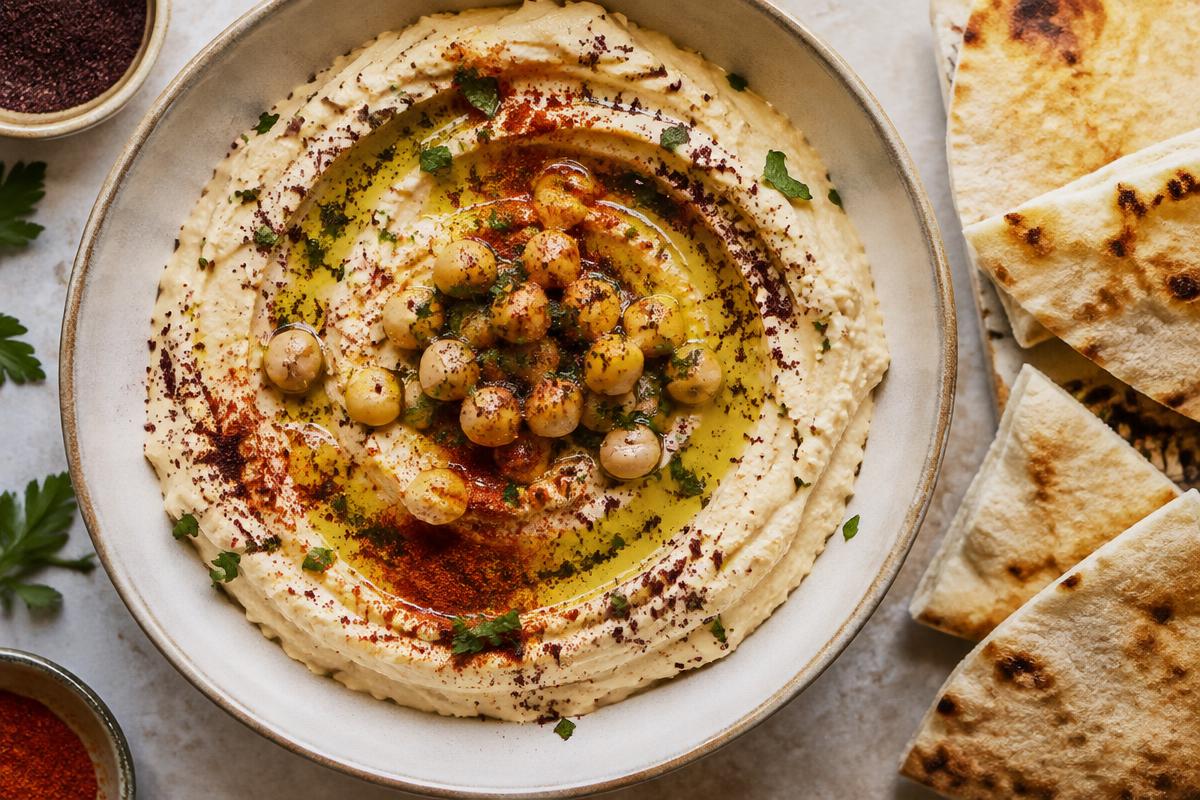
Cultural Provenance: The Holy Grail of the Levantine Mezze
Throughout Lebanon, Palestine, Syria, and Jordan, Hummus bi Tahina (حُمُّص بطحينة—literally "chickpeas with sesame paste") is not a party dip or an afterthought; it is an essential cultural institution that anchors the Levantine Mezze table.
Authentic Levantine hummus bears virtually no resemblance to the sour, gritty, paste-like tubs found in Western supermarket refrigerators, which are frequently adulterated with canola oil, citric acid, red peppers, and garlic powder. In the historic mezze houses of Beirut, Damascus, and Jerusalem, true hummus is an absolute marvel of culinary physics: an ivory-white, feather-light, silky-smooth cream that billows across the plate in swirling waves, offering an ethereal balance of nutty roasted sesame, buttery cooked legumes, clean lemon brightness, and a delicate, rounded garlic whisper.
To achieve this texture without peeling millions of chickpea skins by hand for hours requires an understanding of organic chemistry: specifically, pectin breakdown via alkaline hydrolysis, the enzymatic deactivation of garlic alliinase, and the water-lipid inversion mechanics of pure sesame tahini.
The Molecular Science of Ultra-Smooth Legume Emulsions
1. The Pectin Softening Secret: Alkaline pH Hydrolysis (Baking Soda)
The cellular walls of chickpeas (Cicer arietinum) are exceptionally tough, cemented together by complex structural polysaccharides known as pectins and hemicelluloses, cross-linked by calcium and magnesium ions.
- Why Plain Water Fails: In plain or slightly acidic water, pectin remains rigid. Even after boiling chickpeas for three hours, the individual cells remain intact. When pureed, these microscopic cellular packets do not rupture; they roll against your tongue like microscopic grains of sand, creating a gritty hummus.
- The Alkaline Baking Soda Solution: By adding baking soda (sodium bicarbonate, NaHCO3) to both the soaking water and the boiling pot:
- The alkaline environment raises the water pH to approximately 8.0–8.5.
- The sodium ions displace the calcium and magnesium bridging ions within the pectin matrix.
- The pectin polymers dissolve and disintegrate completely. The skins and cotyledon cells break down into absolute mush, allowing the chickpea starches to hydrate and burst fully. When pureed, the cell walls obliterate into a microscopic fluid suspension with zero grittiness.
2. The Garlic Science: Deactivating the Alliinase Enzyme
One of the greatest flaws of amateur hummus is a harsh, acrid, burning garlic aftertaste that dominates the palate for hours.
- The Chemistry of the Burn: Intact garlic cloves contain a harmless amino acid called alliin and a separate enzyme called alliinase. When garlic is crushed or chopped, the cellular membranes rupture, allowing alliinase to interact with alliin. This instantly synthesizes allicin—the volatile, pungent compound responsible for raw garlic's harsh, sulfurous burn.
- The Acid Deactivation Trick: Alliinase is an enzyme that denatures and becomes permanently inactive at a pH below 3.5.
- By grating or blending fresh garlic directly into freshly squeezed lemon juice (pH ~2.2) and letting it steep for 10 minutes:
- The severe acidity of the lemon juice permanently deactivates the alliinase enzyme before allicin can form.
- The garlic flavor transforms into a mellow, sweet, fragrant essence that complements the sesame without burning the throat.
3. The Sesame Tahini Emulsion Mechanics & Ice Water
Tahini is an oil-in-water suspension of ground sesame seeds containing up to 55% sesame oil and rich proteins.
- The Seizing Phenomenon: When you first add water or lemon juice to tahini, the mixture immediately seizes into a thick, dry, cement-like paste. This occurs because the hydrophilic sesame carbohydrate polymers rapidly absorb the small amount of water.
- The Inversion to Silk: If you continue to add ice-cold water and blend aggressively at high speed, the system undergoes an emulsion inversion. The fat droplets become suspended within a continuous water-protein matrix. The ice water solidifies the tiny sesame fats, while incorporating micro-bubbles of air, transforming the dark tan tahini into an impossibly fluffy, cloud-white, velvety whip.
Deep Ingredient Anatomy & Sourcing
1. Small Dried Chickpeas (Kabuli)
Never use canned chickpeas. Canned chickpeas have been cooked in acidic solutions to retain their firm, round shape, preventing the pectin from ever breaking down into a silky puree. Use dried, small-to-medium chickpeas. Small chickpeas have a higher skin-to-flesh ratio, but when treated with baking soda, their skins dissolve into luscious gelatin.
2. Pure Runny Tahini (The Soul of Hummus)
The quality of your tahini dictates 80% of your hummus’s flavor.
- Avoid thick, bitter, separated, dark brown peanut-butter-like pastes common in Western health food aisles.
- Look for premium Lebanese, Palestinian, or Ethiopian sesame tahini (brands such as Al Kanater, Al Wadi, or Soom). Authentic Levantine tahini is made from lightly roasted, hulled Humera sesame seeds; it is pale blond, completely runny, naturally pourable, sweet, and nutty with zero harsh bitterness.
3. Cold-Pressed Extra Virgin Olive Oil
In the Levant, olive oil is never blended into the hummus base. Blending delicate extra virgin olive oil in a high-speed blender rapidly shears its polyphenols, oxidizing them and turning the hummus bitter. Olive oil is poured exclusively as a luxurious, glistening lake over the plated hummus.
Complete Ingredient Roster
- The Chickpea Base:
- 1 cup (200 g) dry chickpeas (yields ~2.5 cups cooked chickpeas)
- 1 teaspoon baking soda (divided: 1/2 tsp for soaking, 1/2 tsp for boiling)
- 6 cups water for boiling
- The Mellowed Garlic-Lemon Engine:
- 1/3 cup freshly squeezed lemon juice (from 2 large juicy lemons)
- 2 cloves fresh garlic, finely grated on a microplane
- 1 teaspoon fine sea salt (or to taste)
- The Velvet Sesame Emulsion:
- 1 cup (240 g) premium runny Lebanese or Palestinian tahini (stirred well)
- 1/3 to 1/2 cup ice-cold water (with ice cubes)
- 1/2 teaspoon ground cumin (optional, traditional in Beirut for digestion)
- The Traditional Garnish & Mezze Finish:
- 3 tablespoons premium fruity Extra Virgin Olive Oil
- 1 tablespoon whole cooked chickpeas (reserved before pureeing)
- 1 teaspoon ground sumac (tart, burgundy berry powder)
- 1/2 teaspoon Aleppo pepper flakes or sweet paprika
- 1 tablespoon fresh flat-leaf parsley, finely minced
- Warm, fresh-baked pita bread pockets
Step-by-Step Master Method
Phase 1: The Alkaline Soak (18–24 Hours)
- Place the 1 cup of dry chickpeas in a large bowl. Cover with at least 4 inches of cold tap water.
- Stir in 1/2 teaspoon of baking soda.
- Leave on the kitchen counter at room temperature for 18 to 24 hours. The chickpeas will absorb water, expand to more than twice their size, and become tender enough to easily split between two fingers.
- Drain and rinse thoroughly with cold water in a colander.
Phase 2: The High-Heat Pectin Breakdown Boil
- Transfer the drained chickpeas to a heavy pot or Dutch oven.
- Sprinkle with the remaining 1/2 teaspoon of baking soda. Heat the dry pot over medium-high heat for 2 to 3 minutes, stirring the chickpeas constantly. This direct contact with dry heat and baking soda attacks the skins immediately.
- Pour in 6 cups of water. Bring to a vigorous boil over high heat.
- As the pot boils, a thick, frothy white foam carrying dislodged chickpea skins will rise to the surface. Use a fine-mesh skimmer to skim off and discard this foam and any loose skins every 5 minutes.
- Reduce heat to medium. Simmer actively, partially covered, for 45 to 60 minutes.
- The Squish Test: The chickpeas are done when you can crush a single chickpea between your thumb and forefinger with zero effort—it should collapse into an ultra-smooth, buttery paste with no gritty core whatsoever. If there is the slightest resistance, continue boiling.
- Reserve 2 tablespoons of whole cooked chickpeas for garnish. Drain the rest thoroughly in a colander. Let cool for 15 minutes.
Phase 3: The Alliinase Deactivation Steeping
- While the chickpeas boil, grate the 2 garlic cloves directly into a small bowl containing the 1/3 cup of freshly squeezed lemon juice and 1 teaspoon of fine sea salt.
- Whisk to dissolve the salt.
- Let this mixture steep undisturbed for 10 to 15 minutes. The acid will deactivate the alliinase enzyme, eliminating harsh raw garlic burn while preserving sweet garlic aromatics.
- Pour the lemon juice through a fine-mesh strainer into your food processor bowl, pressing the garlic solids with a spoon to extract every drop of flavor (discarding the fibrous garlic pulp for ultra-smooth texture).
Phase 4: Whipping the Tahini
- Add the 1 cup of premium runny tahini to the strained lemon juice in the food processor.
- Secure the lid and process for 1 full minute. Stop and scrape down the sides. The mixture will seize into a thick, pale paste.
- With the processor running on high speed, drizzle in 1/3 cup of ice-cold water in a thin, steady stream.
- Process for 2 continuous minutes. Sensory Cue: Watch through the lid as the paste transforms: the dark tan paste will whip into an impossibly fluffy, voluminous, brilliant ivory-white cloud.
Phase 5: The Hot Puree Emulsion
- Add the warm, thoroughly drained chickpeas and 1/2 teaspoon ground cumin to the whipped tahini in the food processor.
- Process continuously on HIGH for 3 to 4 full minutes.
- Stop, scrape down the sides and base of the bowl with a silicone spatula, and process for another 2 minutes. If the hummus appears too thick or stiff, drizzle in 1 to 2 tablespoons of additional ice water while running.
- Sensory Cue: The hummus should be silky, warm, glossy, and pourable—similar to soft-serve ice cream. (It will firm up slightly as it cools to room temperature).
- Taste and adjust seasoning with a drop more lemon juice or a pinch of salt if necessary.
Phase 6: The Beirut Plating Protocol
- Never serve hummus piled into a deep bowl like dip. Scoop a generous mound of hummus into the center of a wide, shallow ceramic plate.
- Using the back of a large metal spoon, press gently into the center and rotate the plate with your other hand, carving a smooth, sweeping spiral trough around the outer edge with a raised rim.
- Scatter the reserved warm whole chickpeas into the central well.
- Dust one side with vibrant red sumac, another with Aleppo pepper, and scatter chopped flat-leaf parsley across the top.
- Pour 3 tablespoons of rich Spanish or Lebanese extra virgin olive oil generously into the carved trough, filling the moat. Serve at room temperature with warm, puffed pita bread.
Crucial Kitchen Errors & Troubleshooting Matrix
| Problem | Root Food Science Cause | Emergency Kitchen Fix | Long-Term Prevention |
|---|---|---|---|
| Hummus has a gritty, grainy sand texture | Under-cooked chickpeas; pectin remained intact; skins did not dissolve. | Transfer to a high-speed blender (e.g., Vitamix) with 2 tbsp ice water; blend on HIGH for 3 mins. | Use baking soda during both soak and boil; cook until chickpeas completely crush with zero resistance. |
| Harsh, burning garlic aftertaste | Raw garlic pureed directly with legumes, allowing allicin synthesis to run rampant. | Drizzle with extra tahini and fresh lemon juice to dilute volatile allicin compounds. | Steep grated garlic in fresh lemon juice for 10 minutes to denature alliinase enzymes before mixing. |
| Hummus is bitter and astringent | Poor quality, bitter tahini used, or extra virgin olive oil was pureed inside the blender. | Whisk in 1/2 teaspoon honey or sugar and an extra splash of ice water. | Source premium Lebanese/Palestinian runny tahini; never blend olive oil into the machine. |
| Paste is dark brown and dense | Tahini was not whipped with ice water first, or unpeeled un-softened chickpeas were used. | Whip with 3 ice cubes in the machine on high speed for 2 minutes to aerate and bleach emulsion. | Whip tahini, lemon, and ice water into an ivory cloud before introducing warm chickpeas. |