Cultural Provenance: The Street Food of the Levant
From the bustling morning markets of Beirut and Amman to the historic alleyways of Jerusalem and Damascus, falafel is the undisputed heart of Levantine street culture.
While food historians still debate its ancient origins—some tracing it to Coptic Christian communities in Egypt who developed fava-bean fritters (Ta'ameya) as a meatless staple during Lent—the Levantine iteration of falafel perfected the pure chickpea (Hummus) formulation. In Palestine, Lebanon, Syria, and Jordan, falafel is an art of morning artisans. Neighborhood shops fire up immense brass frying vats before dawn, grinding soaked legumes with pungent herbs and pressing them through handheld brass molds (Alep) directly into shimmering, bubbling oil.
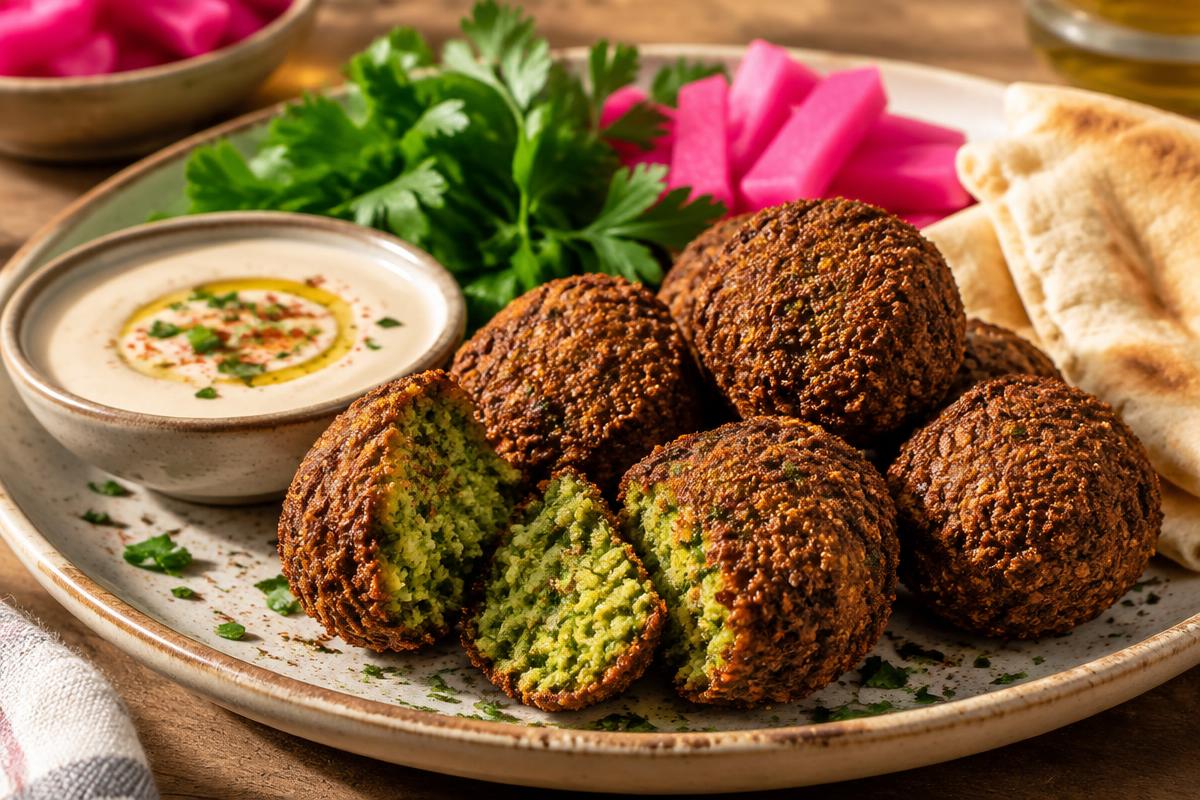
To understand true falafel is to reject the dry, dense, leaden golf balls often served in Western salad bars. An authentic Levantine falafel possesses an impossibly brittle, craggy, deep-brown shell that shatters upon the first bite, revealing an interior that is pale emerald-green, intensely aromatic, and feather-light—steaming, moist, and cake-tender.
The Culinary Physics of Legumes: Why Canned Chickpeas Ruin Falafel
There is one cardinal rule that separates authentic Levantine falafel from an inedible kitchen disaster: You must never, under any circumstances, use canned or cooked chickpeas.
1. The Starch Gelatinization Disaster
- Cooked / Canned Chickpeas: During commercial canning, chickpeas are cooked under high-pressure steam until their starch granules absorb water, swell, and burst—a process known as starch gelatinization. The cell walls rupture, creating a smooth, hydrated puree. When you grind canned chickpeas in a food processor, you create hummus. When you fry that pureed batter, the water trapped inside expands into steam, blowing the fritter apart into the oil or turning the interior into a gummy, pasty, leaden sludge that absorbs grease like a sponge.
- Raw Soaked Chickpeas: Dry chickpeas soaked in cold water for 18 to 24 hours undergo cold hydration. The legume absorbs up to 110% of its dry weight in water, swelling to twice its original volume, but its cellular starch granules remain raw, ungelatinized, and structurally intact.
2. The Internal Steam Engine Mechanics of Frying
When raw soaked chickpeas are ground to the consistency of coarse bulgur or cornmeal and shaped into a ball:
- The Armor Phase: The ball is submerged in hot oil held between 365°F and 375°F (185°C–190°C). The surface moisture flashes into steam instantly, and the exterior chickpea starches gelatinize and fry into a rigid, microscopic lattice of crispy starch and cellulose.
- The Steam Expansion Phase: As heat penetrates into the core, the water inside the raw chickpea cells vaporizes into steam. Because the exterior shell is sealed, this steam expands outward, pushing the chickpea granules apart and creating thousands of micro-cavities.
- The Internal Rise: The chemical leaveners (baking powder and baking soda) react with heat and moisture, releasing carbon dioxide gas. The result is a crumb structure identical to an airy sponge cake—dry heat on the outside, gentle steam-cooking on the inside.
3. The Green Herb Matrix & Moisture Balance
Authentic Levantine falafel gets its vibrant green core not from artificial coloring, but from an aggressive volume of fresh herbs: flat-leaf Italian parsley, fresh cilantro, and a touch of fresh mint or dill.
- The Moisture Control Warning: Fresh herbs contain up to 90% surface water. If washed and thrown directly into the processor, this surface moisture creates a wet, runny paste that collapses in oil. Herbs must be thoroughly spun in a salad spinner and blotted bone-dry with kitchen towels before processing.
Deep Ingredient Anatomy & Roster
1. Dry Chickpeas (Garbanzo Beans)
Select small-to-medium dry chickpeas (often labeled as Kabuli or Turkish chickpeas). Avoid beans that have been sitting on grocery store shelves for years, as their starches may have undergone retrogradation, making rehydration uneven.
2. The Leavening Duet: Baking Soda vs. Baking Powder
- Baking Soda (Sodium Bicarbonate): Added in two stages. A pinch is added to the soaking water to soften the skins by raising pH. A 1/2 teaspoon is added to the ground paste 15 minutes before frying to break down pectin and create a delicate, tender bite.
- Baking Powder: Provides a secondary burst of neutral carbon dioxide under high frying temperatures, guaranteeing that the interior lifts and remains porous.
3. The Whole-Seed Spice Arsenal
Pre-ground spices from jars have lost their aromatic volatile monoterpenes. Toast whole cumin seeds, whole coriander seeds, and whole fennel seeds in a dry skillet, then grind in a spice mill. The high proportion of ground coriander seed provides the floral, citrusy baseline that balances earthy cumin.
Complete Ingredient Roster
- The Legume Base:
- 1 lb (450 g) dry chickpeas (do not substitute canned or cooked chickpeas)
- 1/2 teaspoon baking soda (for the soaking water)
- The Fresh Herb & Aromatic Engine:
- 1 medium yellow or white onion, roughly chopped (approx. 1 cup)
- 6 cloves fresh garlic, peeled
- 1.5 cups tightly packed fresh flat-leaf Italian parsley leaves (stems removed, washed, and dried completely)
- 1 cup tightly packed fresh cilantro leaves and tender upper stems (washed and dried completely)
- 1/4 cup fresh mint leaves or fresh dill leaves (optional, traditional in Beirut)
- 1 small green serrano or jalapeño pepper, seeds removed (for subtle warmth)
- Spices & Seasoning:
- 1.5 tablespoons whole cumin seeds, freshly toasted and ground
- 1.5 tablespoons whole coriander seeds, freshly toasted and ground
- 1 teaspoon Aleppo pepper flakes (or crushed red pepper flakes)
- 1/2 teaspoon ground cardamom (adds an authentic floral Levantine whisper)
- 2 teaspoons fine sea salt (or to taste)
- 1/4 teaspoon freshly cracked black pepper
- The Binders & Leaveners:
- 2 tablespoons toasted white sesame seeds (adds nutty crunch to exterior)
- 1 tablespoon chickpea flour or unbleached all-purpose flour (optional, use only if paste is overly moist)
- 1/2 teaspoon baking soda (added 15 minutes before frying)
- 1/2 teaspoon double-acting baking powder (added 15 minutes before frying)
- Frying Medium:
- 6 cups neutral high-smoke-point oil (avocado, peanut, or high-oleic sunflower oil)
Step-by-Step Master Method
Phase 1: The 24-Hour Cold Hydration
- Place the dry chickpeas in a very large bowl. Inspect and discard any small pebbles or damaged beans.
- Cover with cold tap water by at least 3 to 4 inches (chickpeas will triple in volume).
- Stir in 1/2 teaspoon of baking soda.
- Allow to soak at room temperature for a minimum of 18 hours, ideally 24 hours. Verification Check: When fully soaked, a chickpea should split cleanly in half when pressed between your thumbnail and forefinger; the interior core should be uniform in color with no hard, white, chalky center.
- Drain the chickpeas thoroughly in a colander. Rinse with cold water and let sit for 15 minutes, tossing occasionally to eliminate all surface moisture.
Phase 2: Processing the Falafel Paste (Texture Calibration)
- In the bowl of a large food processor fitted with a sharp multi-blade, add the roughly chopped onion, garlic cloves, serrano pepper, and the thoroughly dried parsley, cilantro, and mint.
- Pulse 8 to 10 times until the herbs and aromatics are finely minced but not pureed into liquid.
- Add the drained, raw chickpeas in two batches if your processor bowl is under 12-cup capacity.
- Add the toasted ground cumin, ground coriander, Aleppo pepper, ground cardamom, fine sea salt, and black pepper.
- The Pulsing Rhythm: Pulse the mixture in short, 1-second bursts, stopping every 4 to 5 pulses to scrape down the sides of the bowl with a silicone spatula.
- Tactile Texture Test: You are aiming for the consistency of fine couscous or coarse sand. Rub a pinch of paste between your thumb and forefinger: it should feel granular, not smooth. If you pinch a walnut-sized ball in your palm, it should easily hold its shape without crumbling, yet break apart cleanly when tapped. If it feels like hummus, it has been over-processed.
- Transfer the falafel mixture to a clean glass bowl. Stir in the toasted sesame seeds. Cover with plastic wrap and refrigerate for at least 1 hour (up to 24 hours). Chilling solidifies natural starch molecules, allowing the balls to hold together during shaping.
Phase 3: The Pre-Fry Activation & Shaping
- Pull the chilled falafel mixture from the refrigerator.
- Sprinkle the 1/2 teaspoon baking soda and 1/2 teaspoon baking powder evenly across the mixture.
- Using your clean hands, knead the mixture for 60 seconds to evenly distribute the leaveners. Let rest on the counter for 10 minutes to activate.
- If using a traditional handheld brass falafel tool (Alep): dip the tool in water, pack the hollow mold with paste without compressing it too tightly, scrape the surface flat, and release the lever to drop the patty.
- If shaping by hand: lightly wet your palms with cold water. Scoop 2 tablespoons of paste (about 30 grams) and gently shape into a rounded disc or ball (approx. 1.5 inches in diameter). Crucial Technique: Do not compress the ball tightly like a meatball! Pack it just enough so it holds together; dense compression prevents steam expansion and creates hard falafel.
Phase 4: Frying Aerodynamics
- Pour 3 inches of neutral oil into a heavy cast-iron skillet or Dutch oven. Insert a deep-fry candy/probe thermometer.
- Heat oil over medium-high heat until it reaches a stable 370°F (188°C).
- Carefully lower 5 to 6 falafel balls into the hot oil using a spider skimmer. Do not overcrowd the pot; adding too many balls drops the oil temperature below 340°F, causing the falafel to absorb grease and disintegrate.
- The oil will bubble vigorously as moisture vaporizes. Maintain temperature between 355°F and 365°F during frying.
- Fry undisturbed for 90 seconds until the bottom crust is set, then use a slotted spoon to gently roll them over.
- Fry for a total of 3.5 to 4 minutes until the exterior achieves a dark, deep-amber, rustic mahogany color.
- Transfer the fried falafel with a spider skimmer to a wire cooling rack set over a baking sheet. (Never drain on paper towels; paper towels trap steam beneath the crust, turning crisp shells soggy within 60 seconds). Sprinkle immediately with a whisper of fine sea salt.
The Velvet Levantine Tarator (Garlic-Tahini Sauce)
A hot falafel must be doused in authentic Tarator sauce:
- The Physics of Tahini Emulsion: Stirring cold water into pure sesame paste (tahini) initially causes the sesame seed proteins and lipids to seize into a thick, cement-like paste. Continue whisking vigorously: as water incorporates, the proteins invert into a brilliant white, glossy, pourable velvet emulsion.
- Master Recipe: Whisk 1/2 cup premium pure Lebanese or Palestinian runny tahini, 1/3 cup ice-cold water, 3 tablespoons freshly squeezed lemon juice, 2 finely grated garlic cloves, and 1/2 teaspoon fine sea salt until smooth and creamy.
Crucial Kitchen Errors & Troubleshooting Matrix
| Symptom | Root Scientific Cause | Emergency Kitchen Fix | Long-Term Prevention |
|---|---|---|---|
| Falafel completely disintegrates into oil gravel | Canned/cooked chickpeas used, excess water on herbs, or oil temperature was below 340°F (170°C). | Form remaining paste into flat patties and pan-sear in a nonstick skillet with 2 tbsp oil. | Use dry soaked chickpeas only; dry herbs thoroughly; verify oil is at 370°F before dropping balls. |
| Crust is burned black, but interior is raw and wet | Oil temperature was too hot (>390°F / 200°C), scorching exterior starches before heat reached core. | Transfer undercooked balls to a 350°F (175°C) oven for 5–7 minutes to bake through. | Keep oil stabilized between 365°F and 375°F; adjust stovetop burner dynamically. |
| Interior is dense, heavy, and rubbery | Mixture was over-processed into puree, or balls were squeezed too tightly in hand. | None for current batch; serve with extra tahini sauce to mask density. | Pulse until granular like couscous; shape with light, feather-soft pressure. |
| Falafel tastes flat and bland | Under-salted paste; raw chickpeas absorb immense amounts of sodium during frying. | Dust hot, fresh-out-of-the-oil falafel with sumac, sea salt, and ground cumin. | Taste raw paste (it is safe; contains only herbs and soaked legumes) and ensure salt tastes slightly pronounced before frying. |