Cultural Provenance: The Imperial Tribute of Governor Ding
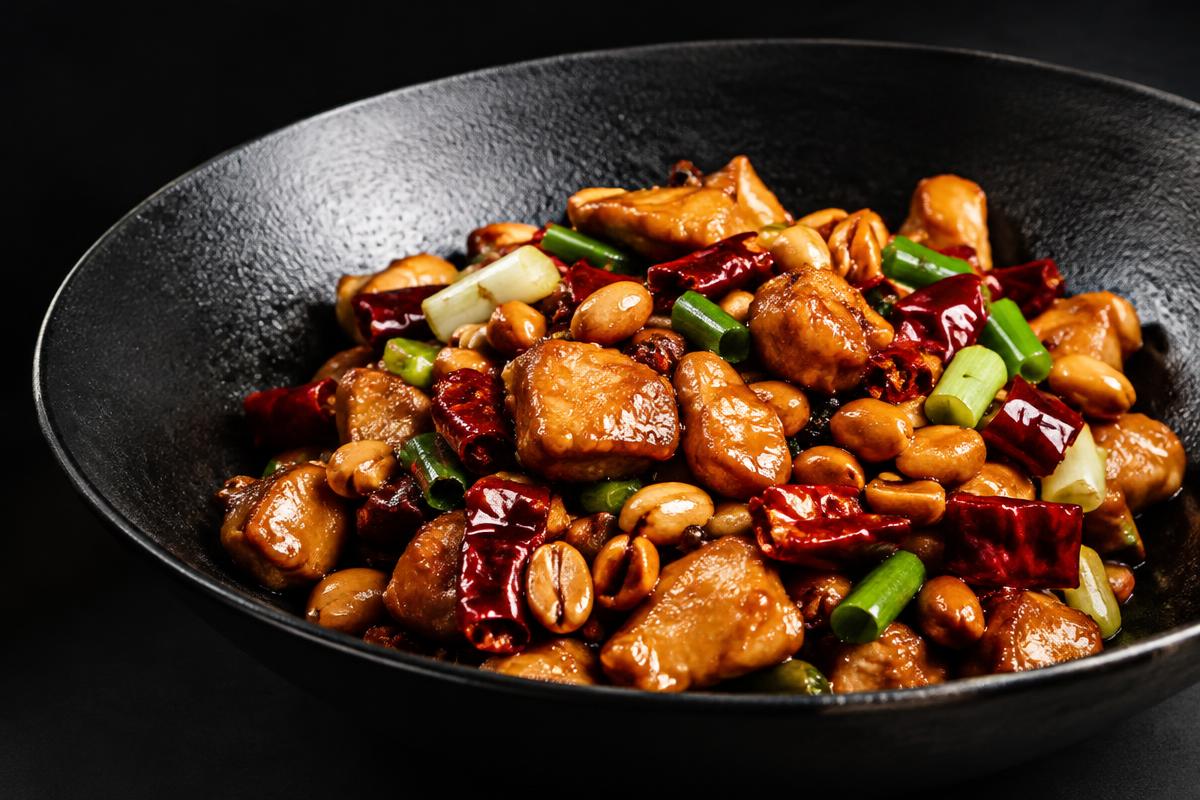
Few dishes in the global Chinese canon have been more heavily westernized—and diminished—than Kung Pao Chicken (Gong Bao Ji Ding - 宫保鸡丁). In Western takeout restaurants, it is frequently debased into a syrupy, sweet-and-sour stir-fry bogged down with bell peppers, zucchini, celery, and generic sweet chili sauce.
In authentic Sichuan culinary tradition, Gong Bao Ji Ding is an aristocrat of classical technique, named in honor of Ding Baozhen (1820–1886), a Qing Dynasty official who served as the Governor of Sichuan Province. Because Ding held the imperial title of Taizi Shaobao (Palace Guardian, colloquially called Gongbao), the chicken dish created by his family chef became known as Gong Bao Ji Ding ("Palace Guardian's Diced Chicken").
Authentic Kung Pao Chicken is defined by a strict, classical Sichuan flavor profile known as Lìzhī Wèi (荔枝味—Lychee Flavor). It contains no actual lychee fruit; rather, it is a masterclass in balance where sweet, sour, and salty interplay so delicately that the sauce mimics the floral, sweet-tart lusciousness of fresh lychee, offset by the fierce numbing crackle of whole Sichuan peppercorns (Huajiao) and the nutty crunch of deep-fried peanuts.
The Molecular Science of Wok Cookery: Velveting & Spice Blooming
1. The Science of Velveting (Shang Jiang 上浆)
Chicken breast is notorious for turning chalky, stringy, and dry in a hot wok. Chinese chefs overcome this through velveting (water-velveting or oil-velveting):
- Alkaline Hydration & Starch Shielding: Diced chicken is massaged vigorously with salt, Shaoxing wine, light soy sauce, an egg white, and potato starch.
- The salt alters the ionic charge of actin and myosin muscle proteins, enabling them to absorb and bind external liquid.
- The egg white provides soluble albumen proteins, while potato starch forms a thin, gelatinous micro-membrane around each chicken cube.
- When the chicken hits hot oil, the surface starch instantly gelatinizes, forming an impermeable thermal shield. The chicken breast cooks gently in its own trapped steam, emerging unbelievably tender, succulent, and velvety.
2. The Chemistry of Lychee Flavor (Lìzhī Wèi)
In Sichuan flavor categorization (Ershisi Wei—the 24 Classical Flavor Profiles), Lìzhī Wèi is governed by a precise mathematical balance between Zhenjiang black rice vinegar (Chinkiang), white sugar, light soy sauce, and rich stock.
- The vinegar’s acetic and malic acids react with sucrose under high wok heat, undergoing rapid caramelization.
- The sauce must form a tight, glossy glaze (Bao Zhi) that clings intimately to the chicken cubes without pooling in the bottom of the plate.
3. Whole-Spice Oil Blooming: The Black-Bright Boundary
The foundational mistake of amateur cooks is using pre-ground chili powder or powdered pepper. Authentic Kung Pao chicken demands whole dried Facing Heaven chiles (Chao Tian Jiao) or Erjingtiao chiles and whole Sichuan peppercorns.
- The Temperature Window: The whole dried chiles must be snipped into 1/2-inch batons and fried in warm oil (around 280°F–300°F / 140°C–150°C) until they turn from bright red to a deep, dark burgundy-mahogany (Zong Hong).
- At this precise micro-second, the capsaicinoids and aromatic pyrazines are unlocked into the oil without charring into bitter black ash.
Deep Ingredient Anatomy & Sourcing
1. The Poultry Cut: Thigh vs. Breast
While historical banquet Kung Pao used tender chicken breast, modern Chinese culinary masters prefer boneless, skinless chicken thighs. Thigh meat has higher intramuscular fat and myoglobin, providing superior flavor and resilience under intense wok heat. Cut into uniform 3/4-inch (2 cm) cubes (Ji Ding).
2. The Vinegar: Chinkiang Black Rice Vinegar (镇江香醋)
Do not use white distilled vinegar, cider vinegar, or sweet Japanese rice vinegar. Authentic Chinkiang black rice vinegar is brewed from fermented glutinous rice and wheat bran, aged in earthenware vats. It is malty, deeply savory, and slightly smoky with gentle acidity.
3. The Allium: Leek Batons vs. Celery
Authentic Kung Pao chicken never contains celery, bell peppers, or carrots. The only vegetable permitted is Chinese leeks or scallion whites, cut into cylindrical batons exactly the same size as the chicken cubes (Ji Ding). They provide crisp, sweet, oniony bursts.
4. The Peanuts: Raw Shelled Peanuts
Never use stale, salted, roasted cocktail peanuts from a can. Authentic Sichuan kitchens use raw shelled peanuts, fry them slowly in cold peanut oil until golden and brittle, and drain them. They are tossed into the wok in the final 5 seconds so they retain a shattering crunch.
Complete Ingredient Roster
- The Chicken & Velveting Marinade:
- 1 lb (450 g) boneless, skinless chicken thighs (or breast), cut into 3/4-inch (2 cm) uniform cubes
- 1/2 teaspoon fine sea salt
- 1 tablespoon Shaoxing cooking wine
- 1 teaspoon light soy sauce
- 1 tablespoon cold water
- 1 tablespoon egg white (approx. half a large egg white), beaten lightly
- 1 tablespoon potato starch (or cornstarch)
- 1 teaspoon peanut oil (seals the marinade)
- The Lychee-Flavor Sauce (Lìzhī Wèi):
- 1.5 tablespoons Chinkiang black rice vinegar
- 1.5 tablespoons granulated white sugar
- 1 tablespoon light soy sauce
- 1/2 teaspoon premium dark soy sauce (for rich caramel color)
- 2 tablespoons unsalted rich chicken stock
- 1 teaspoon potato starch (or cornstarch)
- 1/2 teaspoon pure toasted sesame oil
- The Whole Aromatics & Spices:
- 3 tablespoons pure peanut oil (divided)
- 15–20 dried Sichuan Erjingtiao or Facing Heaven chiles, snipped into 1/2-inch batons and seeds shaken out
- 1 teaspoon whole Sichuan red peppercorns (Hanyuan grade)
- 4 cloves fresh garlic, sliced thinly
- 1 tablespoon fresh ginger, peeled and thinly sliced into coins
- 4 scallions, white and pale green parts only, sliced into 3/4-inch (2 cm) cylindrical batons
- 1/2 cup raw shelled peanuts (fried until golden, or unsalted roasted peanuts)
Step-by-Step Master Method
Step 1: Velveting the Chicken
- Place the cubed chicken into a mixing bowl. Add the 1/2 teaspoon salt, 1 tablespoon Shaoxing wine, 1 teaspoon light soy sauce, and 1 tablespoon cold water.
- Using clean hands, vigorously massage the chicken in one continuous circular direction for 60 seconds until all liquid is absorbed into the meat fibers.
- Add the 1 tablespoon egg white and 1 tablespoon potato starch. Massage until a smooth, velvety coating envelops each chicken cube.
- Drizzle the 1 teaspoon of peanut oil over the chicken to prevent the cubes from sticking together in the pan. Let rest at room temperature for 15 minutes.
Step 2: Mixing the Lychee Sauce
- In a small bowl, whisk together the Chinkiang black vinegar, white sugar, light soy sauce, dark soy sauce, chicken stock, potato starch, and sesame oil.
- Stir thoroughly until the sugar is completely dissolved. Set by your stovetop.
Step 3: Flash-Frying the Peanuts (Skip if using pre-roasted)
- In a clean wok or small skillet, add 1/3 cup peanut oil and 1/2 cup raw peanuts over medium-low heat.
- Fry slowly for 4 to 5 minutes, stirring constantly as the nuts sizzle and turn a light golden amber.
- Immediately remove with a slotted spoon to a paper-towel-lined plate. They will continue to crisp as they cool.
Step 4: The Rapid Wok Assembly (Under 4 Minutes)
- Heat a 14-inch seasoned carbon steel wok over high heat until wisps of blue smoke rise. Swirl in 3 tablespoons of peanut oil (Long You).
- Add the marinated chicken cubes. Immediately spread them across the wok with your spatula. Let sear undisturbed for 20 seconds, then stir-fry rapidly over high heat for 90 seconds until the chicken cubes separate and turn opaque white (about 80% cooked).
- Transfer the chicken and any cooking oil to a clean bowl.
Step 5: Blooming the Spices & Aromatics
- Return the hot wok to medium-low heat (leaving about 1 tablespoon of residual oil).
- Add the snipped dried chiles and whole Sichuan peppercorns all at once.
- Stir-fry gently over medium-low heat for 20 to 30 seconds. Sensory Cue: Watch the chiles closely. The moment they turn from bright scarlet to a rich, deep burgundy-red and the air fills with an intoxicating spicy-citrus perfume, immediately proceed. (Do not let them turn black!).
- Add the sliced garlic, sliced ginger, and scallion batons. Increase heat to high and stir-fry for 15 seconds until fragrant.
Step 6: Glazing and The Lychee Finish
- Return the seared chicken cubes to the wok. Toss vigorously over maximum heat for 30 seconds to mingle the chicken with the spiced oil.
- Re-stir your prepared Lychee sauce to redistribute the potato starch.
- Pour the sauce directly into the center of the smoking wok.
- Toss furiously with your spatula. Within 15 seconds, the intense heat will cause the sauce to bubble, gelatinize, and gloss into a tight lacquer that clings directly to each chicken cube (Bao Zhi).
- Turn off the heat. Dump in the crispy fried peanuts.
- Give 2 final tosses to distribute the peanuts without allowing them to soften in the steam. Slide immediately onto a serving plate. Serve scalding hot with steamed Jasmine rice.
Crucial Kitchen Errors & Troubleshooting Matrix
| Issue | Culinary Cause | Kitchen Fix | Prevention |
|---|---|---|---|
| Chicken is dry, chalky, and tough | Velveting was skipped, or chicken was severely overcooked (>3 mins in wok). | None for current batch; serve with extra lychee sauce over rice. | Massage chicken with starch, egg white, and wine; flash-fry for only 90 seconds. |
| Dish tastes bitterly burnt and acrid | Dried chiles or Sichuan peppercorns scorched over excessive heat. | Discard scorched chiles before serving; add a pinch of sugar. | Bloom whole spices over medium-low heat; proceed the instant chiles turn dark burgundy. |
| Sauce is watery and pools at the bottom | Starch slurry was not stirred before adding, or wok heat was too low to gelatinize. | Tilt wok and let sauce bubble over high heat for 20 seconds to reduce and tighten. | Re-whisk sauce immediately before pouring; ensure wok is roaring hot. |
| Peanuts are soft and soggy | Peanuts were added too early in the cooking process and steamed in the sauce. | Scatter freshly roasted crispy peanuts across the top before serving. | Add peanuts strictly in the final 5 seconds after heat is turned off; toss twice and plate. |