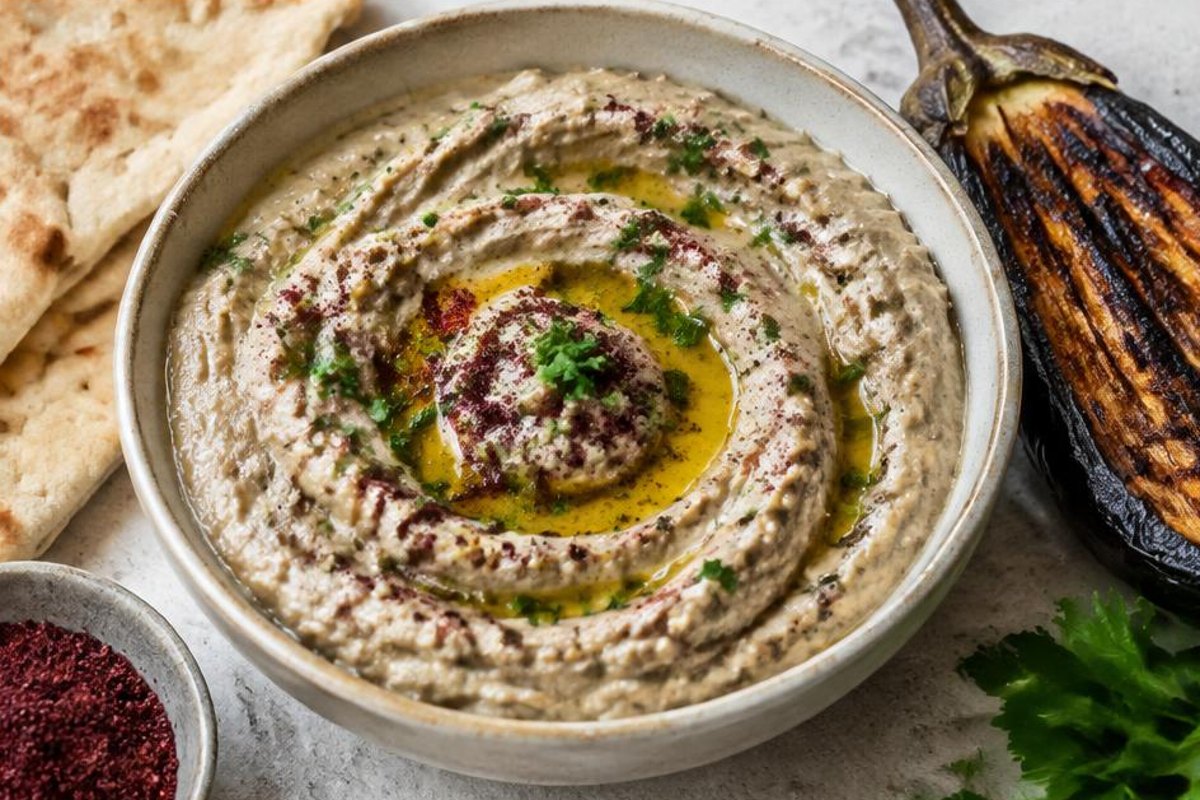
A useful naming distinction
In English-language search, “baba ganoush” often refers to smoky eggplant mixed with tahini, lemon, and garlic. In parts of the Levant, cooks and writers distinguish this tahini-rich dip, often called mutabal or moutabal, from a chunkier eggplant salad that may be called baba ghanoush and include tomato, pepper, or onion. Usage varies across households, restaurants, and countries, so the terms are not perfectly standardized. To respect both the popular search term and this distinction, this article calls the recipe smoky eggplant mutabal and notes that many readers know it as baba ganoush. 1 2 3
The core ingredients are few: eggplant, tahini, lemon, garlic, salt, and sometimes olive oil. The defining flavor comes from deeply tender, smoky eggplant. Moisture control then determines whether the texture is concentrated and creamy or watery. Serious Eats recommends strong charring and draining excess moisture; hand-mixing rather than puréeing preserves a pleasant texture. 4
Ingredients
- 2 medium Italian eggplants, about 2 lb (900 g) total
- ¼ cup (60 g) well-stirred tahini
- 2 tbsp fresh lemon juice, plus more to taste
- 1 small garlic clove, finely grated or crushed to a paste
- ½ tsp fine salt, then adjust
- 1 tbsp extra-virgin olive oil, plus more to finish
- Optional: pinch cumin, chopped parsley, sumac, or pomegranate seeds
- Warm pita, cucumber, radish, carrots, or other vegetables for serving
Choose the eggplant and plan your char
Italian eggplants are convenient and often have tender flesh. Smaller globe eggplants also work. Choose firm fruit with taut, glossy skin and no soft spots. Weighing the eggplant is more useful than counting pieces because water content varies.
Gas burner: Set eggplant directly over a medium-high flame on a sturdy rack. Turn with tongs every few minutes until the skin is blackened in patches and the flesh collapses throughout, about 15–25 minutes depending on size. The surface should be blistered, and the eggplant should feel very soft when pressed with tongs. Use ventilation and never leave an open flame unattended.
Broiler: Prick the eggplants a few times with a fork to release steam. Place on a foil-lined tray close to the broiler. Turn every 5–8 minutes until deeply charred and collapsed, roughly 25–40 minutes. Broiler intensity differs; rely on softness, not the clock.
Oven: For a less smoky but easy method, roast at 450°F (230°C) until very tender, about 35–50 minutes, turning once. For more smoke, finish briefly under the broiler or char the cooked skins over a gas flame. A high-heat char is valued for deep smoky flavor in recipe testing. 4
Drain and cool the flesh
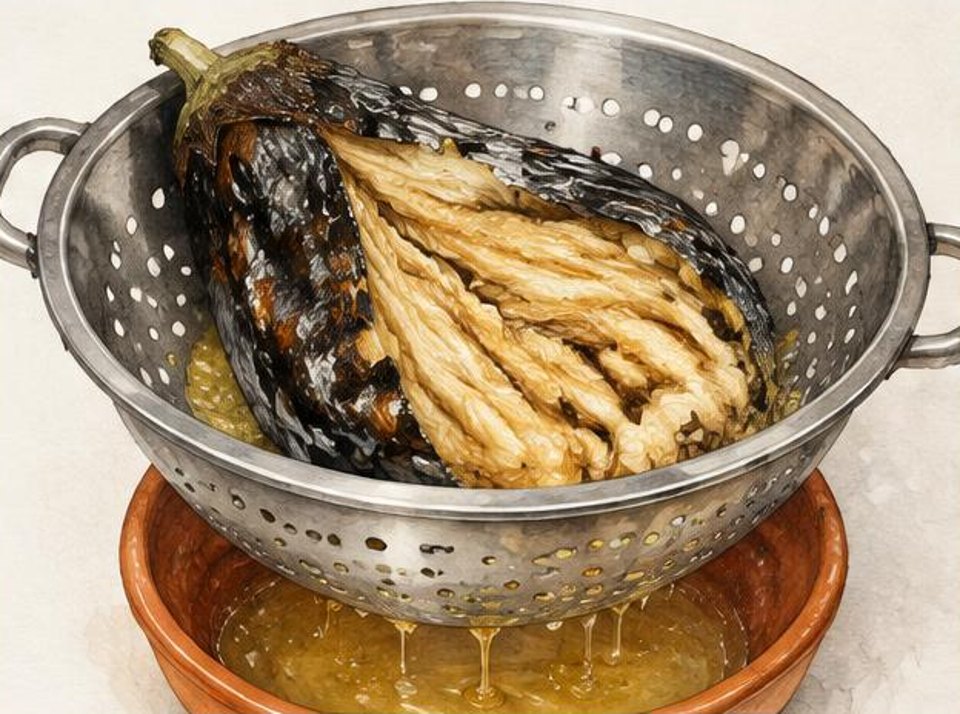
Let cooked eggplants cool until safe to handle. Split lengthwise and scoop flesh into a colander set over a bowl. Avoid scraping too much of the charred skin into the flesh unless you want a stronger smoky edge. Let drain 10–20 minutes. For a thicker dip, gently press or spin the flesh to remove additional liquid. Do not squeeze it completely dry; a little moisture keeps the dip lush.
If the eggplant is visibly watery, drain longer. Serious Eats notes that removing excess moisture produces a creamier result, and uses a salad spinner as a practical alternative to slow draining. 4
Mix into a textured dip
Mash garlic with salt into a paste on a cutting board, using the side of a knife. In a bowl, whisk tahini and lemon juice. The mixture may tighten at first; whisk in 1–2 tablespoons cold water gradually until creamy and spoonable. Add eggplant flesh and mash with a fork, leaving some small pieces. Stir in olive oil. Taste and adjust salt, lemon, and garlic.
For a very smooth dip, pulse briefly in a food processor, but avoid overprocessing: the texture can become gluey or overly uniform. Hand-mixing gives a chunkier, more rustic texture, as highlighted by Serious Eats’ comparison. 4
Balance the flavor deliberately
- Too smoky or bitter: Remove more charred skin, add a little lemon and tahini, and check salt.
- Too flat: Add salt first, then lemon. Smoke and garlic can mask a lack of salt.
- Too sharp: Add tahini and a drizzle of olive oil rather than sugar.
- Too thick: Whisk in cold water a teaspoon at a time.
- Too loose: Drain longer, or stir in a small spoonful of tahini; chilling also firms it slightly.
- Too garlicky: Let it rest 20–30 minutes; garlic flavor disperses and intensifies as it sits, so start with less.
Rest the dip in the refrigerator at least 30 minutes before serving so the flavors meld. Bring it toward room temperature for serving, taste once more, and add a shallow swirl of olive oil, parsley, or sumac.
Serving, storage, and variations
Serve as part of a mezze spread with hummus, olives, chopped salad, pita, and crunchy vegetables. A dish of this sort is built for sharing, but the dip also works in sandwiches with roasted vegetables or as a sauce alongside grilled meat. The Mediterranean Dish describes versions across Egypt and the Levant, with family differences around tahini and seasoning. 5
Refrigerate in a sealed container and use within 3–4 days for best quality. Stir before serving; if it has thickened, loosen with a teaspoon of water or lemon. Freezing is possible but can make the texture watery after thawing, so fresh is preferable.
For a chunkier eggplant salad style without tahini, fold the roasted flesh with diced tomato, green pepper, onion, parsley, lemon, and olive oil. This is not the same preparation as tahini-rich mutabal, though English-language menus sometimes use “baba ganoush” for either. Epicurious and KQED both discuss the naming and textural distinction through the perspective of Arab cooks and chef Reem Assil. 1 2