
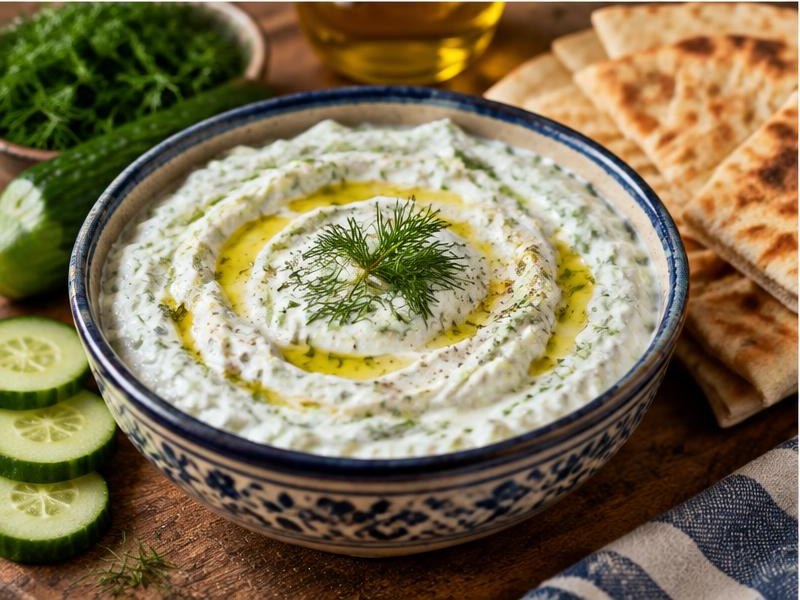
Tzatziki is cool, tangy, garlicky, and designed to play a supporting role: it cuts the richness of grilled meat, balances warm bread, and brings freshness to vegetables. Its ingredients are familiar, but one small omission reliably ruins the texture: cucumber must be drained. Cucumber is mostly water; if that water goes straight into the bowl, a thick yogurt dip can turn thin as it rests.
There is no need to treat every family or regional version as identical. Greek preparations commonly use strained yogurt, cucumber, garlic, olive oil, and dill; some cooks add vinegar or lemon, and herb preferences vary. Taste and texture matter more than asserting a single rigid formula. The culinary mechanics here rest entirely on cellular osmosis: raw cucumber is more than 95 percent water, bound within thin plant cell walls. Salting collapses those cells through osmotic pressure, releasing cellular moisture into the bowl rather than letting it seep out slowly into the lactic acid matrix of your strained yogurt over dinner.
A dependable formula
Makes about 600–700 g, enough for 6–8 as a condiment:
- 500 g full-fat Greek-style strained yogurt
- 250–300 g cucumber, preferably English or Persian
- 1 small garlic clove, finely grated (about 3–4 g); add more only after tasting
- 1 tbsp extra-virgin olive oil, plus a little to finish
- 1–2 tsp white wine vinegar or lemon juice, optional
- 1 tbsp finely chopped fresh dill, or mint if that is the flavor you prefer
- ½ tsp fine salt for the cucumber, plus more to taste
- Black pepper, optional
Greek-style strained yogurt is convenient, but ordinary plain yogurt can be strained through cheesecloth or a clean coffee filter in the refrigerator until thick. The time varies with the yogurt; several hours may be enough, while very loose yogurt can need overnight. Use the whey in baking or smoothies rather than pouring it into the finished dip.
Salt and drain the cucumber before mixing
Wash and dry the cucumber. Peel it if the skin is thick or waxed; thin-skinned English and Persian cucumbers can be left unpeeled for color and texture. If using a large seedy cucumber, split it lengthwise and scrape out the watery seed center. Coarsely grate the flesh.
Toss the grated cucumber with ½ teaspoon salt and leave it in a sieve over a bowl for 15–20 minutes. Salt creates a concentration difference that draws water from the cucumber. Then gather it in a clean towel and squeeze firmly over the sink. The goal is not to make it bone-dry; it should still taste fresh and feel moist, but it should no longer release a stream of liquid when pressed.
This step concentrates cucumber flavor as well as protecting thickness. If you skip salting, you can still squeeze the cucumber thoroughly, but the dip is more likely to loosen as it sits. Do not solve a watery bowl by adding extra garlic or oil; remove moisture at the beginning.
Prepare the garlic with restraint
Finely grate the garlic or crush it to a paste with a pinch of salt. Grating distributes it more evenly than chopping into large pieces. Start with one small clove. Raw garlic becomes more prominent over time, so a bowl that tastes gently garlicky immediately after mixing can taste much sharper an hour later. If you want a strongly pungent dip, add more after the first chill rather than beginning with several cloves.
Garlic's sharpness is not a flaw to eliminate. It is part of the condiment's character. But a large quantity can dominate cucumber and yogurt, especially after the flavors mingle. Let the dip rest and taste again before deciding to increase the garlic.
Mix without making it loose
Put the yogurt in a bowl and stir until smooth. Fold in the drained cucumber, garlic, olive oil, dill, and optional vinegar or lemon. Add salt gradually, remembering the cucumber was already salted. The mixture should hold a soft mound on a spoon and leave a clear track when you drag the spoon through it. If it pours like dressing, check whether the cucumber was squeezed enough and whether the yogurt was truly strained.
Olive oil contributes aroma and a rounded mouthfeel. Whisking or folding it into the thick yogurt disperses it; pouring a heavy stream on top is a fine garnish but does not integrate the flavor. Acid is optional: a little can brighten a rich yogurt, but too much makes the sauce sharp and thinner. Add it by teaspoons and taste after each addition.
Cover and chill for at least 30 minutes; 1–2 hours gives the garlic and herbs time to spread through the yogurt. The dip may thicken slightly when cold. Stir once before serving and taste for salt and acidity again. Finish with a small drizzle of olive oil, fresh dill, and perhaps a few cucumber pieces.
Troubleshooting texture and flavor
It became watery in the refrigerator. The cucumber was not drained enough, the yogurt was too loose, or the salt pulled out more water after mixing. Stir, then strain the finished dip briefly through a fine sieve if necessary. Next time, salt and squeeze the cucumber more firmly and use strained yogurt. Do not add flour or starch; they make the texture pasty.
It tastes too garlicky. Fold in more yogurt and cucumber, or let it rest another hour; the flavor may mellow into the base. A little additional olive oil can round it, but won't remove the garlic. For the next batch, start with half a clove and increase after chilling.
It tastes flat. Add salt in small pinches first. If it is seasoned but still dull, add a few drops of vinegar or lemon and taste again. Salt improves perception of the cucumber and garlic; acid adds brightness, but they are not interchangeable.
It tastes too sour. The yogurt may itself be tangy, or too much acid was added. Stir in more yogurt and a small amount of olive oil. A tiny pinch of sugar can round the edges, but it should not make the sauce sweet.
It feels grainy. Some yogurts have a naturally coarse texture, or the mixture was vigorously beaten. Whisk the yogurt smooth before adding the cucumber. If it is already mixed, a brief gentle stir may help; aggressive blending can break the texture and make the cucumber watery.
The herbs taste muted. Use fresh herbs, chop them just before mixing, and add a small fresh garnish immediately before serving. Dried herbs can work in a pinch, but they do not provide the same bright, leafy aroma.
How to serve it
Tzatziki belongs beside grilled foods and bread, but it is useful beyond a mezze platter. Serve it with Greek pork souvlaki, roasted potatoes, grilled vegetables, or warm pita. It also makes a cool counterpoint to Greek moussaka, though it should be served on the side so the baked dish keeps its browned top. Use it as a sandwich sauce or dip for raw vegetables, but avoid adding it to a hot pan: heat can separate the yogurt and dull the fresh garlic and herbs.
Tzatziki is related in spirit to a broad family of cucumber-and-yogurt preparations across the eastern Mediterranean and neighboring regions, but names, herbs, texture, and service differ. If writing about those connections, describe the shared idea without claiming that one version is simply another cuisine's dish. This keeps cultural context accurate while still helping readers understand the family resemblance.
Make-ahead, storage, and food safety
Tzatziki can be made several hours ahead and kept covered in the refrigerator. For best texture, use it within 2–3 days. Stir before serving and discard if it has been left at room temperature for more than two hours, or sooner in very hot conditions. Use a clean spoon each time and keep it chilled between servings. Do not freeze it: thawed yogurt and cucumber typically separate and become watery.
For meal prep, prepare the cucumber and yogurt separately and combine them closer to serving time. If you must make it a day ahead, drain the cucumber thoroughly and keep the finished dip cold. The flavors develop, but the cucumber continues to release moisture, so the squeeze is especially important.
Variations that preserve the core idea
- Dill-forward: Use 1–2 tablespoons chopped dill, with lemon for brightness.
- Mint-forward: Use fresh mint for a cooler, more aromatic profile; use less at first because mint can take over.
- More rustic texture: Dice the cucumber finely instead of grating it, but still salt and drain it.
- Dairy-free adaptation: A thick, unsweetened plant-based yogurt can be used, but brands differ widely in acidity and thickness. Drain it first and season gradually. This is an adaptation rather than a like-for-like replacement.
- Lighter version: Lower-fat strained yogurt works, but the sauce may feel less rounded. Drain the cucumber especially well and avoid adding too much acid.
Serve this tzatziki alongside freshly baked Mediterranean pita or as the cooling counterpoint to seasoned, grilled Greek pork souvlaki.
A strong tzatziki is not complicated: thick yogurt, cucumber with excess water removed, restrained raw garlic, good olive oil, and enough salt and acid to make the flavors vivid. Drain first, season in stages, chill, then taste once more before it reaches the table.