Cultural Provenance: From Ottoman Levant to the Modern Greek Masterpiece
Few dishes define the celebratory Greek Sunday family table more magnificently than Moussaka (μουσακάς).
The word traces its lineage to the Arabic musaqqa‘ah (literally "chilled" or "moistened"), an Ottoman Levantine stew of eggplants, tomatoes, and ground meat eaten at room temperature. For centuries across Greece and the Balkans, moussaka remained a rustic, peasant homestyle bake.
However, the towering, architectural, three-layered masterpiece we celebrate today was codified in the 1920s by Nicholas Tselementes, the founding father of modern Greek culinary literature. Tselementes, who trained in classical French palaces in Vienna and Paris, believed that Greek cooking needed European structure. He introduced a thick, baked top layer of French Béchamel sauce, enriched with egg yolks and pungent Greek sheep's milk cheese (Kefalotyri).
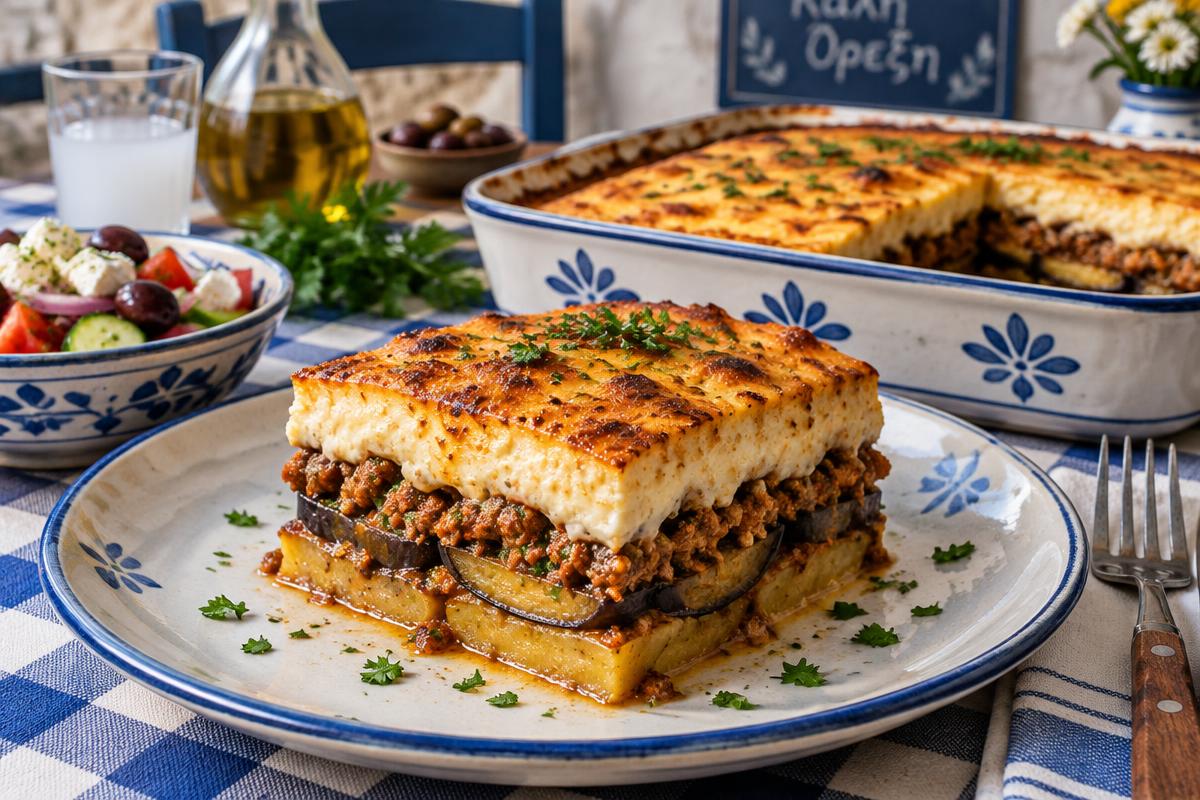
In authentic Greek gastronomy, moussaka is a culinary symphony of three distinct, harmonious strata:
- The Roasted Foundation: A base layer of thinly sliced, golden roasted potatoes (which provide structural rigidity), topped with sweet, velvety caramelized eggplant slices.
- The Aromatic Lamb Ragù: A rich, deeply spiced meat sauce infused with red wine, grated tomatoes, cinnamon, whole allspice, and oregano, cooked until virtually all free moisture has evaporated.
- The Soufflé-Béchamel: A billowy, golden-crusted, two-inch layer of egg-custard béchamel that puffs in the oven and sets into a sliceable, creamy cloud.
Culinary Physics & Food Science: Cellular Collapse & Structural Integrity
1. The Cellular Physics of Eggplant: Osmotic Desiccation
The number one reason home-cooked moussaka turns into a watery, greasy swamp is improper eggplant preparation.
- The Sponge Microstructure: The flesh of raw eggplant (Solanum melongena) consists of spongy parenchymal tissue with massive intracellular air pockets containing up to 92% water. If raw eggplant is fried in oil, it functions like a dry sponge, absorbing up to its own weight in hot fat. Later, during oven baking, the heat collapses the cells, releasing this trapped fat and water into the casserole, drowning the meat.
- The Osmotic Salting Solution:
- Slicing the eggplant and generously salting both sides creates an osmotic gradient.
- Water is drawn out through the cell membranes, carrying with it bitter solanine alkaloids.
- The air pockets collapse. When roasted in an oven with a light brush of olive oil, the dehydrated flesh caramelizes quickly without absorbing excess grease, yielding a dense, silky, sweet foundation.
2. The Zero-Moisture Ragù Rule
A common error is pouring a wet Bolognese-style sauce into the moussaka. If the meat sauce has free liquid, that liquid will boil during baking, rising into the béchamel layer and causing the casserole to collapse when sliced.
- The meat ragù (traditionally made from ground lamb or beef chuck) must be simmered uncovered until zero free liquid remains in the pan. The sauce should be dense, thick, and held together by reduced tomato pectin and meat gelatin.
3. The Custard Béchamel Chemistry (The Tselementes Technique)
Standard French béchamel is a simple roux of butter, flour, and milk. If poured on moussaka, standard béchamel remains liquid, spilling out like gravy when cut.
- The Greek innovation is the enrichment with egg yolks and hard sheep's cheese (Kefalotyri or Graviera):
- The egg yolks introduce lecithin and heat-coagulable proteins (vitellin) that set between 150°F and 160°F (65°C–71°C).
- As the casserole bakes, the trapped air in the roux expands, puffing the béchamel slightly like a soufflé, while the proteins set into a firm, golden, custard-like crust that can be sliced with razor-sharp clean edges.
4. The 45-Minute Resting Thermodynamics
You must never cut moussaka fresh out of the oven. At 375°F (190°C), the starches in the béchamel and the gelatins in the meat are completely liquid.
- As the moussaka rests at room temperature for 35 to 45 minutes, the starches undergo partial retrogradation, the fats solidify, and the egg proteins lock in place. The casserole cools from burning hot to the traditional Mediterranean serving temperature: warm, aromatic, and perfectly structurally sound.
Deep Ingredient Anatomy & Sourcing
1. The Meat: Lamb vs. Beef
In traditional Greek tavernas, moussaka is prepared with fresh ground lamb shoulder, which provides an earthy sweetness that pairs magnificently with cinnamon and allspice. However, many Athens households use a 50/50 blend of ground lamb and ground beef chuck to achieve a balanced, rounded richness.
2. The Spices: The Levantine Warmth
The meat sauce is flavored with warm, aromatic spices that distinguish Greek ragù from Italian sugo:
- True Ceylon Cinnamon Stick: Simmered in the sauce (or 1/2 teaspoon ground cinnamon).
- Whole Allspice Berries (Bahari): Pungent clove-nutmeg warmth.
- Dry Greek Red Wine (Agiorgitiko or Cabernet): Adds tannins and acidity to cut lamb richness.
3. The Cheese: Kefalotyri (Κεφαλοτύρι)
Kefalotyri is a hard, salty, unpasteurized sheep and goat milk cheese with a sharp, tangy, nutty bite. It browns into a stunning golden mosaic under broiler heat. (If unavailable, substitute with authentic Pecorino Romano or aged Parmigiano-Reggiano).
Complete Ingredient Roster
- The Vegetable Foundation:
- 3 medium globe eggplants (approx. 2 lbs / 900 g), ends trimmed, sliced lengthwise into 1/3-inch (8 mm) thick planks
- 2 large Yukon Gold potatoes (approx. 1 lb / 450 g), peeled and sliced into 1/4-inch rounds (the traditional structural base)
- Coarse sea salt (for sweating eggplants)
- 1/3 cup Greek Extra Virgin Olive Oil (for brushing)
- The Spiced Lamb Ragù:
- 2 lbs (900 g) ground lamb (or 1 lb lamb + 1 lb lean ground beef chuck)
- 1 large yellow onion, finely diced
- 4 cloves garlic, finely minced
- 2 tablespoons tomato paste
- 1/2 cup dry Greek red wine (or dry red wine)
- 1 can (14 oz / 400 g) crushed San Marzano tomatoes or grated fresh tomatoes
- 1 cinnamon stick (approx. 3 inches)
- 3 whole allspice berries (bahari), lightly crushed (or 1/4 tsp ground allspice)
- 1 bay leaf
- 1 teaspoon dried Greek oregano
- 1 teaspoon fine sea salt (or to taste)
- 1/4 teaspoon freshly cracked black pepper
- 2 tablespoons fresh flat-leaf parsley, finely chopped
- The Rich Custard Béchamel:
- 6 tablespoons (85 g) unsalted butter
- 6 tablespoons (60 g) unbleached all-purpose flour
- 4 cups (1 liter) whole milk, warmed
- 1/2 teaspoon freshly grated whole nutmeg (non-negotiable)
- 1/2 teaspoon fine sea salt
- 1/4 teaspoon ground white pepper
- 3 large egg yolks, lightly beaten
- 1 cup (100 g) Greek Kefalotyri cheese (or Pecorino Romano), finely grated (divided: 3/4 cup for sauce, 1/4 cup for top crust)
Step-by-Step Master Method
Phase 1: Osmotic Eggplant Sweating & Vegetable Roasting
- Lay the sliced eggplant planks in a single layer on wire racks or clean kitchen towels. Sprinkle generously on both sides with coarse sea salt.
- Let sit for 30 minutes. You will see dark brown beads of moisture forming across the surface like sweat.
- Thoroughly blot and press the eggplant slices bone-dry with paper towels, wiping away excess salt and bitter liquids.
- Preheat oven to 400°F (200°C). Line two large baking sheets with parchment paper.
- Arrange the sliced potatoes in a single layer on one tray. Brush lightly with olive oil and season with salt. Roast for 20 minutes until tender and lightly golden.
- Arrange the salted, dried eggplant slices on the second tray. Brush both sides lightly with olive oil. Roast for 20 to 25 minutes until soft, collapsed, and golden brown with caramelized edges. Remove and set aside.
Phase 2: Simmering the Zero-Moisture Spiced Ragù
- Heat a large, wide Dutch oven or deep skillet over medium-high heat. Add the ground lamb/beef.
- Cook, breaking up the meat into fine crumbles with a wooden spoon for 6 to 8 minutes until browned. Drain off excess rendered fat if excessive, leaving about 2 tablespoons in the pan.
- Add the finely diced onion and garlic. Sauté for 5 minutes until soft and translucent.
- Stir in the 2 tablespoons of tomato paste. Cook for 2 minutes, toasting the paste against the pan base until dark brick red.
- Pour in the 1/2 cup red wine, scraping up all browned bits (fond) from the bottom of the pan. Simmer for 2 minutes until the alcohol scent cooks off and wine reduces by half.
- Add the crushed tomatoes, cinnamon stick, crushed allspice berries, bay leaf, dried oregano, salt, and black pepper.
- Reduce heat to medium-low. Simmer uncovered for 30 to 35 minutes, stirring occasionally.
- The Zero-Moisture Test: Drag a wooden spoon across the bottom of the pot. A clean channel should hold for 3 seconds without liquid filling the void. Remove the cinnamon stick, allspice berries, and bay leaf. Stir in the chopped fresh parsley. Remove from heat.
Phase 3: The Custard Béchamel
- In a heavy saucepan, melt the 6 tablespoons of butter over medium heat.
- Add the 6 tablespoons of flour. Whisk continuously for 2 minutes to cook out the raw flour taste, creating a pale blond roux.
- In a slow, steady stream, pour in the 4 cups of warm milk while whisking vigorously to prevent lumps.
- Bring to a gentle simmer, whisking constantly. Cook for 4 to 5 minutes until the sauce thickens into a heavy, velvety cream that coats a spoon thickly.
- Remove from heat. Whisk in the freshly grated nutmeg, salt, and white pepper.
- Let cool for 5 minutes (to prevent curdling the eggs). Whisk in the 3 beaten egg yolks and 3/4 cup of the grated Kefalotyri cheese until completely smooth and incorporated.
Phase 4: Architectural Assembly
- Lightly grease a deep 9x13-inch (23x33 cm) ceramic or metal baking pan.
- Layer 1 (The Potato Armor): Arrange the roasted potato slices across the bottom of the dish in a snug, overlapping layer. Sprinkle with 1 tablespoon of grated cheese.
- Layer 2 (The Eggplant Cushion): Arrange the roasted eggplant slices evenly over the potatoes, creating a dense vegetable stratum.
- Layer 3 (The Spiced Ragù): Spread the warm meat sauce evenly across the eggplant layer, pressing down firmly with the back of a spatula to compress the layers and eliminate air pockets.
- Layer 4 (The Béchamel Crown): Pour the warm custard béchamel over the meat, smoothing the top with an offset spatula into a flawless, even, two-inch sheet.
- Scatter the remaining 1/4 cup of grated Kefalotyri cheese evenly across the béchamel surface.
Phase 5: Baking & The Mandatory Rest
- Bake uncovered at 375°F (190°C) on the middle oven rack for 45 to 50 minutes.
- Visual Cue: The béchamel will puff slightly, and the top will turn a deep, golden-amber color with appetizing dark brown spots across the cheese crust.
- Remove from the oven. DO NOT ATTEMPT TO CUT.
- Place the baking pan on a wire rack and allow it to rest undisturbed for at least 45 minutes (up to 1 hour).
- Using a sharp chef's knife, slice into clean, towering squares. Lift each portion with a wide metal spatula and plate. The layers will stand proud, showcasing the dark potatoes, caramelized eggplant, spiced meat, and the billowy, golden custard béchamel.
Crucial Kitchen Errors & Troubleshooting Matrix
| Issue | Culinary Physics Cause | Emergency Fix | Long-Term Prevention |
|---|---|---|---|
| Casserole collapsed into liquid mush upon slicing | Cut while boiling hot, or meat sauce had excess free water that steamed the layers. | Scoop into shallow pasta bowls; flavor is still magnificent. | Rest moussaka for a full 45 mins before cutting; simmer meat sauce until bone-dry. |
| Béchamel is runny and spills like milk soup | Egg yolks were omitted, or roux was under-thickened. | None for current batch; serve with toasted crusty bread to sop up sauce. | Whisk 3 egg yolks into warm béchamel; bake until cheese browns and custard sets. |
| Eggplants taste oily and greasy | Raw eggplant was fried in a pan without osmotic salting, absorbing excess oil. | Blot surface of baked moussaka with paper towels to absorb released oils. | Salt eggplant slices for 30 mins, squeeze dry, and oven-roast with minimal brushed oil. |
| Top burned before interior heated through | Oven rack was too high, or oven temperature was inaccurate. | Tent loosely with aluminum foil for the remaining bake time. | Bake on the middle or lower-middle rack at 375°F (190°C). |