Corn tortillas look simple because their ingredient list is simple: masa harina, water, and usually a little salt. The skill lies in getting the dough hydrated and the cooking surface hot enough that each tortilla sets quickly without drying out. Once you understand those two controls, the process becomes repeatable rather than mysterious.
This guide uses masa harina, the dried flour made from nixtamalized corn. It is not interchangeable with ordinary cornmeal or polenta. Traditional nixtamalization cooks and steeps dried maize in an alkaline solution (historically wood ash, now predominantly food-grade calcium hydroxide), which dissolves the outer pericarp and denatures kernel proteins. As detailed in CIMMYT's maize processing research, this alkaline steeping frees bound niacin (vitamin B3) to prevent nutritional deficiencies like pellagra while infusing bioavailable calcium into the endosperm. Crucially for cooks, the interaction between calcium ions and gelatinized starch is what allows ground nixtamal to bind water into an elastic, rollable dough rather than slumping into a gritty porridge.
The formula and what it is meant to feel like
For about 12 small tortillas:
- 200 g masa harina
- 280–310 g warm water, beginning with 280 g
- 3 g fine salt, optional
A volume approximation is 2 cups masa harina to about 1¼ cups warm water, but weighing is more reliable because brands and measuring habits vary. Keep another 20–30 g water nearby for adjustment. Do not add it all automatically: the correct amount depends on the flour's grind, age, and storage.
Mix the masa harina and salt, then stir in 280 g warm water. When it looks evenly damp, knead by hand for 1–2 minutes. At first the mixture can seem sandy. Give it time: the particles need to absorb water. The finished dough should feel like soft modeling clay, hold a ball without sticking to your palm, and form a smooth edge when pressed. It should not smear onto your fingers, nor should it fracture like dry clay.
Cover and rest for 15–20 minutes. This is not idle time. The rest lets water distribute into the corn particles, so dough that initially felt dry may become more pliable. Recheck afterward. If a test ball develops small cracks around its edge when flattened, knead in water 1 teaspoon at a time. If it sticks heavily to your hands or plastic, knead in masa harina a teaspoon at a time and let it rest again for several minutes.
Why nixtamalized masa behaves differently from cornmeal
Untreated cornmeal does not become tortilla dough by simply adding water. In nixtamalization, alkaline cooking loosens the pericarp and changes starch and protein behavior. Masa harina is made from this treated corn, then dried and milled. Water rehydrates it into a cohesive dough. That is why the correct product label matters: look for masa harina or flour for tortillas, not corn flour, cornmeal, or polenta. Because grain varieties, milling fineness, and residual moisture vary across producers, the tactile feedback of the dough is always a more dependable test than adhering rigidly to a single liquid ratio on the packaging.
Shape evenly before pressing
Divide the rested dough into 12 pieces, roughly 40 g each. Roll each into a smooth ball and keep the unused portions covered with a damp towel or plastic wrap. Exposed masa dries quickly at the surface; that dry skin later creates ragged edges and cracks.
A tortilla press is convenient, but two flat plates or a heavy skillet can work. Line the press with a cut-open food-safe plastic bag or reusable press liners. Parchment can wrinkle and absorb water; waxed paper is not ideal because it can stick. Put one dough ball slightly off-center between the plastic sheets, close the press, and apply even pressure. Rotate the tortilla 180 degrees and press once more if its thickness is uneven.
Aim for a thin round about 14–15 cm (5½–6 inches) across. The exact diameter is less important than uniform thickness. A thick center and thin rim cook unevenly: the rim dries before the middle sets. If the pressed edge splits into several deep cracks, the masa is too dry. If it tears and smears as you peel it from the liner, it is too wet or too thin. Adjust the dough before pressing the remaining batch.
Heat the comal, then cook by cues
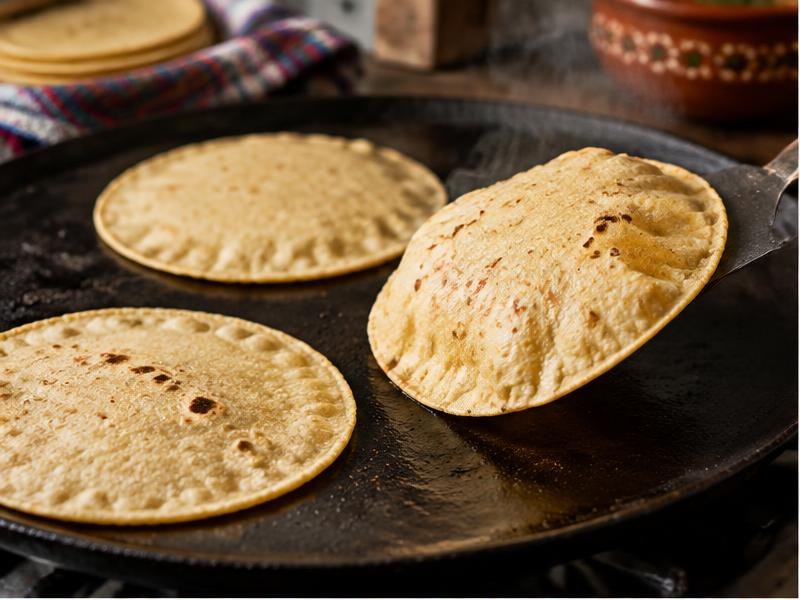
Heat a dry cast-iron skillet, carbon-steel pan, or comal over medium-high heat for several minutes. A surface around 220–250°C (430–480°F) is a useful working range when measured with an infrared thermometer, but the pan and burner matter. The visual test is more practical: a drop of water should skitter briefly and evaporate, not sit and slowly simmer. Avoid smoking the pan for a long time; excessive heat scorches the outside before the tortilla becomes flexible.
Cook each tortilla in three stages:
- First side: Lay it on the hot surface. Cook about 25–35 seconds, until the top loses its wet shine and the edges begin to look set. A few pale toasted spots are good; dark black patches at this stage mean the pan is too hot.
- Second side: Flip and cook about 35–45 seconds. The tortilla may begin to inflate in places.
- Final side: Flip again and cook another 15–30 seconds, gently pressing the center with a spatula or clean towel if needed. A well-hydrated tortilla may puff, fully or partially.
Times are guides, not a contract. If the surface stays wet and the tortilla sticks, give it a little longer before flipping. If it becomes stiff and brittle, the pan may be too cool or it has cooked too long. A puff is a welcome sign that steam has separated the two sides, but it is not the only measure of success. A tortilla can be tender without a dramatic balloon; repeated puffing often improves as dough hydration and pan temperature become consistent.
Stack finished tortillas in a clean kitchen towel inside a covered basket or lidded container. The trapped warmth softens them through gentle steaming. Do not leave them exposed on a plate: they lose moisture quickly.
Troubleshooting: diagnose the symptom, not the recipe
The dough cracks when I flatten it. The masa is underhydrated or has dried while uncovered. Knead in a teaspoon of warm water, rest 5 minutes, then test another ball. Small hairline cracks can be normal; deep breaks that reach the center are not.
The dough sticks to the liner. It is too wet, insufficiently rested, or the liner is creased. Knead in masa harina in small increments, rest, and smooth the plastic. Avoid dusting the outside heavily with flour; loose flour burns on the comal.
The tortillas are dry or break when folded. Common causes are a dough that was too dry, overcooking, low pan heat that forces a long cook, or failing to keep the stack covered. Correct one variable at a time. Start by adding a little water and shortening the cook once the surface has set.
The tortilla browns but feels raw or pasty inside. The pan may be too hot, or the tortilla too thick. Reduce heat slightly and press thinner, more evenly. The tortilla should smell like warm corn and feel pliable, not gummy.
It never puffs. Check that the tortilla is evenly thin, the dough is supple, and the pan is adequately hot. Pressing gently on the center during the last stage can help. But do not chase puffing by leaving it on the heat until it dries out.
The tortillas stick together in the stack. They may be undercooked or stacked while very wet from condensation. Cook until the surface is set and use a dry, clean towel. A little steam is helpful; pooled water is not.
Keeping, reheating, and freezing
Fresh tortillas are best the day they are cooked. Cool them fully before refrigeration, then store in an airtight bag or container for up to 3 days. Reheat on a dry hot skillet for roughly 20–30 seconds per side, or wrap a small stack in a barely damp towel and warm briefly in the microwave. Reheated tortillas become flexible when warm, so serve immediately or keep covered.
To freeze, cool completely, separate tortillas with small pieces of parchment if they tend to stick, and seal well. Thaw in the refrigerator or reheat from frozen on a skillet over moderate heat, turning frequently. Avoid freezing a warm stack: trapped condensation turns into ice and damages the texture.
Variations and what not to change casually
A pinch of salt makes the corn flavor read more clearly, but it is optional. Some cooks add a small amount of fat for a softer, more tender result; this changes the character and is not necessary for a basic tortilla. Blue, yellow, and white masa harina can all be used, though their aroma, water absorption, and flavor differ. Start with the package's suggested ratio and adjust by feel.
Once you have warm tortillas off the comal, pair them immediately with rich braised meats like Michoacán carnitas or charred, citrus-marinated carne asada.
The most useful rule is simple: make the dough supple, press evenly, cook quickly on a properly heated surface, and hold the tortillas covered. Those fundamentals are more dependable than adding oil or repeatedly changing the recipe.