Cultural Provenance: The Sacred Aztec Stew of the Corn God
Pozole (from the Nahuatl pozolli, meaning "frothy" or "boiled") is perhaps the most ancient and culturally revered dish in Mexican culinary civilization.
Long before the Spanish Conquest, pozole was a ceremonial dish served to Aztec nobility and priests during religious feasts dedicated to Xipe Totec, the god of agriculture, fertility, and renewal. In indigenous Mesoamerican cosmology, humans were literally sculpted from corn by the gods (Hombres de Maíz). Preparing pozole was a ritual of spiritual communion: large kernels of sacred corn were cooked until they ruptured, blooming like white flowers (florear), giving the stew its legendary frothy appearance.
Following the arrival of the Spanish, European pork replaced ceremonial game, and the stew became the crown jewel of family celebrations, Mexican Independence Day (September 16), and Christmas Eve across the western states of Jalisco and Michoacán.
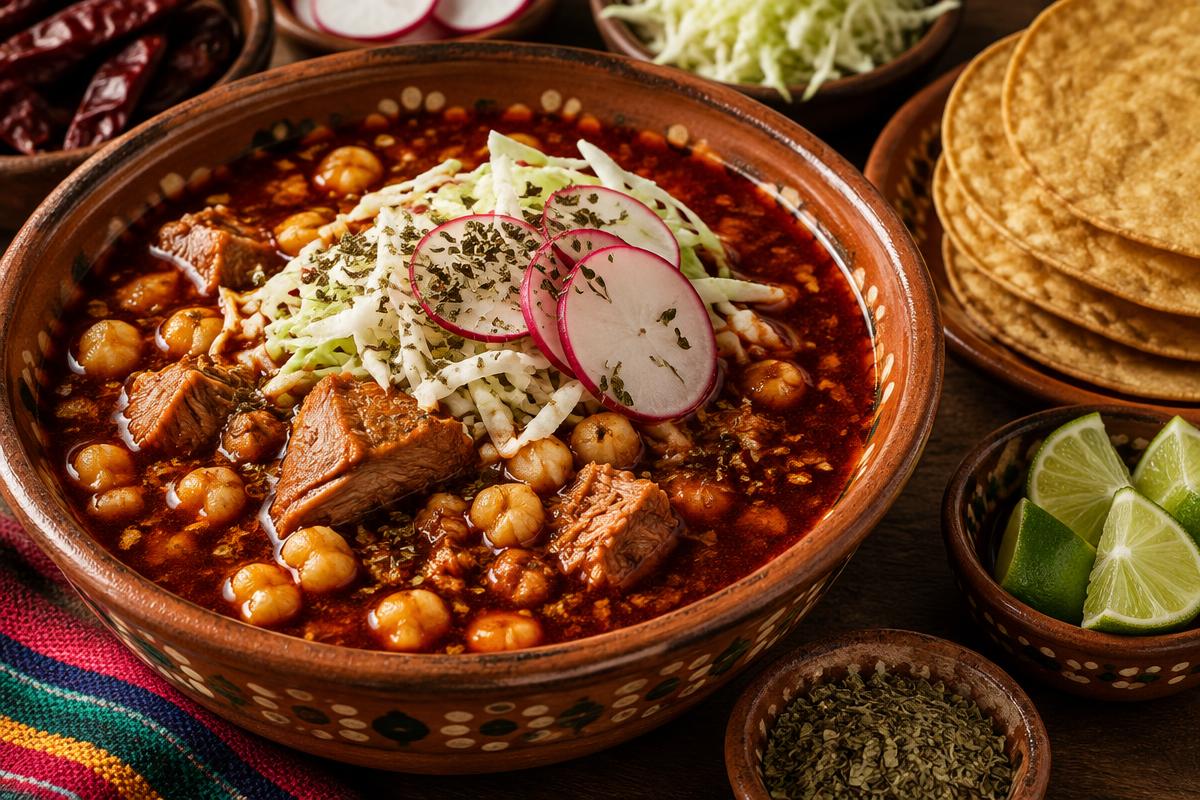
An authentic Pozole Rojo estilo Jalisco is not a quick chili soup. It is a slow-simmered, majestic stew featuring huge, blossomed kernels of nixtamalized corn, fork-tender pork infused with bone marrow and collagen, and a lustrous, brick-red broth forged by emulsifying pureed toasted guajillo and ancho chiles directly into simmering pork fat.
Culinary Physics & Food Science: Nixtamalization and Gelatin Broth
1. The Ancient Miracle of Nixtamalization (Nextli + Tamalli)
The soul of pozole is cacahuazintle corn (giant white heirloom hominy). Raw field corn is biologically indigestible to humans; its starch kernels are locked behind an impenetrable outer hull (pericarp), and its essential nutrients are chemically bound.
- The Alkaline Reaction: Pre-Columbian Mesoamericans developed nixtamalization—soaking and cooking dry maize in an alkaline water bath made from wood ashes or slaked lime (calcium hydroxide, Ca(OH)2).
- The Chemical Transformations:
- The high pH (around 11.0–12.0) dissolves the hemicellulose in the tough outer pericarp, allowing it to slip off effortlessly.
- The alkaline calcium bonds chemically release niacin (Vitamin B3) and essential amino acids (lysine and tryptophan), transforming corn from a nutritionally deficient grain into a complete dietary staple that prevented pellagra across the Americas.
- The starch inside the endosperm absorbs water and calcium ions, allowing the giant kernels to split open and bloom into tender, cloud-like nuggets (florear) during the long simmer.
2. The Collagen-to-Gelatin Matrix (Pork Anatomy)
A thin, watery pozole broth is a failure. An authentic Jalisco pozole broth must have a velvety, lip-smacking viscosity that coats the palate.
- This viscosity cannot be achieved with chicken broth or lean pork alone. It requires collagen-rich cuts: pork trotters (manitas de cerdo), pork neck bones (espinazo), and pork shoulder (espaldilla).
- As collagen cooks at a gentle simmer (190°F–205°F / 88°C–96°C) over three hours, the triple-helix collagen protein fibers slowly unwind and hydrolyze into liquid gelatin. When spooned hot, gelatin lends rich, unctuous body; as it cools, it sets.
3. Frying the Chile Paste (Guisar el Chile)
The signature brick-red color and complex flavor of Pozole Rojo come from dried Guajillo and Ancho chiles.
- If pureed chiles are poured raw directly into the stock, the broth will taste harsh, bitter, and raw.
- In classical Mexican technique, the rehydrated chile puree must be strained through a fine sieve to remove bitter seed bits and skins, then fried in hot rendered pork lard for 5 to 7 minutes (guisar). Frying in fat activates pyrazines and caramelizes natural sugars, transforming the chile paste into an aromatic, glossy, sweet-smoky red velvet base that emulsifies seamlessly into the simmering pork broth.
Complete Ingredient Roster
- The Corn Base:
- 2 cans (29 oz / 820 g each) prepared Mexican white hominy (maíz pozolero / cacahuazintle), drained and thoroughly rinsed in cold water (or 1 lb dry cacahuazintle soaked and pre-cooked)
- The Pork & Broth Engine:
- 3.5 lbs (1.6 kg) bone-in pork Boston butt (shoulder), cut into large 2.5-inch (6 cm) chunks
- 1.5 lbs (700 g) pork neck bones or pork trotters (manitas), split in half (essential for gelatin extraction)
- 1 large whole white onion, cut in half
- 1 whole head of garlic, unpeeled, top 1/4 inch sliced off to expose cloves
- 4 fresh bay leaves
- 1 tablespoon coarse sea salt
- 16 cups (4 quarts / 3.8 L) cold water
- The Red Chile Adobo Base (El Adobo Rojo):
- 8 dried guajillo chiles, stemmed and seeded
- 3 dried ancho chiles, stemmed and seeded
- 2 dried chiles de árbol (optional, for authentic spicy bite)
- 4 cloves garlic, peeled
- 1/2 medium white onion, roughly chopped
- 1.5 teaspoons dried Mexican oregano, crushed
- 1/2 teaspoon ground cumin
- 1/4 teaspoon ground black pepper
- 1 tablespoon pure rendered pork lard (manteca)
- The Fresh Crisp Table Garnishes (Non-Negotiable):
- 4 cups green cabbage or iceberg lettuce, shredded paper-thin
- 1 cup finely diced white onion
- 1 bunch fresh red radishes, washed and sliced into wafer-thin coins
- 1/4 cup dried Mexican oregano (served in small bowls for rubbing between palms)
- Dried crushed red pepper flakes or ground chile piquín
- Fresh Mexican Key limes, cut into wedges
- Crisp Mexican corn tostadas and Mexican crema
Step-by-Step Master Method
Phase 1: Establishing the Rich Pork & Gelatin Broth (2 Hours)
- In a massive stockpot (12 to 16 quarts), place the pork shoulder chunks, pork neck bones/trotters, halved white onion, halved garlic head, bay leaves, and 1 tablespoon coarse sea salt.
- Pour in the 16 cups of cold water.
- Bring to a rolling boil over high heat. A grey, foamy scum of denatured surface proteins will rise to the top. Use a wide ladle or fine-mesh skimmer to meticulously skim and discard this foam for the first 15 minutes until the broth runs clear.
- Reduce the heat to medium-low. Cover partially with the lid ajar and simmer gently for 1.5 to 2 hours. Maintain a gentle simmer (approx. 195°F / 90°C). The meat should be tender when pierced with a fork, and the connective tissues on the trotters will begin to gelatinize.
Phase 2: Building and Frying the Chile Adobo
- While the broth simmers, heat a dry cast-iron skillet over medium heat. Toast the guajillo, ancho, and árbol chiles for 10 to 15 seconds per side until fragrant.
- Transfer chiles to a bowl, cover with 2 cups of boiling water, and let soften for 15 minutes.
- In a blender, add the rehydrated chiles, 1 cup of their soaking liquid, the 4 peeled garlic cloves, chopped 1/2 onion, Mexican oregano, cumin, and black pepper.
- Blend on high speed for 90 seconds until completely liquefied.
- The Straining Gate: Pour the chile puree through a fine-mesh sieve set over a bowl, using the back of a ladle to press the rich paste through while catching every fragment of tough chile skin.
- In a skillet, melt 1 tablespoon of lard over medium heat. Pour the strained chile puree into the hot fat. Cook at a brisk simmer for 6 to 8 minutes, stirring constantly until the color deepens to dark mahogany and the oil glistens on the surface.
Phase 3: Uniting the Corn, Meat, and Chile (1 Hour)
- Remove the spent onion halves, garlic head, and bay leaves from the pork stockpot and discard.
- Using tongs, remove the large chunks of pork shoulder to a cutting board. Shred into bite-sized, juicy pieces. Leave the neck bones and trotters in the pot to continue shedding gelatin and marrow. Return the shredded pork to the pot.
- Add the thoroughly drained, rinsed hominy (maíz) to the simmering pot.
- Pour the fried red chile adobo into the pot, stirring thoroughly to incorporate. The entire stew will transform into a glowing, volcanic brick-red broth.
- Simmer uncovered over medium-low heat for 45 to 60 minutes.
- Culinary Indicators: The corn kernels will absorb the red chile broth and bloom fully (florear). The broth will turn silky, glossy, and fragrant with oregano and pork essence. Taste and adjust salt generously—hominy absorbs significant amounts of salt.
Phase 4: The Ceremonial Table Service
- Ladle the piping-hot pozole into wide, deep ceramic Mexican bowls, ensuring each guest receives a generous portion of bloomed corn kernels, tender pork shreds, and rich, red broth.
- The Garnish Ceremony: Pozole is completed at the table by each diner. Provide bowls of shredded cabbage, wafer-thin radish coins, diced raw white onion, Mexican oregano (which guests crush between their palms over the bowl), and fresh lime wedges.
- Serve alongside crisp golden tostadas spread lightly with Mexican crema.
Crucial Kitchen Errors & Troubleshooting Matrix
| Issue | Culinary Cause | Kitchen Fix | Prevention |
|---|---|---|---|
| Broth is bitter, astringent, and harsh | Chiles burned during toasting, or raw chile paste added without frying in fat. | Stir in 1/2 teaspoon white sugar and a splash of fresh chicken stock; simmer 10 mins. | Toast chiles lightly (<15 secs); always fry the strained adobo in lard before adding to soup. |
| Broth is thin and watery like tinted water | Only lean boneless pork used; no collagen-rich bones or trotters included. | Whisk 1 packet (7g) unflavored powdered gelatin in cold water and stir into simmering broth. | Always include pork trotters (manitas) or neck bones to build a natural gelatin foundation. |
| Hominy is hard and chewy | Undercooked dry hominy used, or canned hominy not simmered long enough. | Simmer for an additional 30–45 minutes over medium heat until kernels burst. | Use authentic Mexican canned hominy (cacahuazintle); rinse well and simmer at least 45 mins. |
| Stew is excessively greasy with a thick oil cap | Unskimmed pork shoulder fat pooled on the surface. | Chill soup overnight and peel off solidified fat cap, or skim surface with a ladle of ice cubes. | Skim surface fats with a ladle during the final 15 minutes of simmering. |