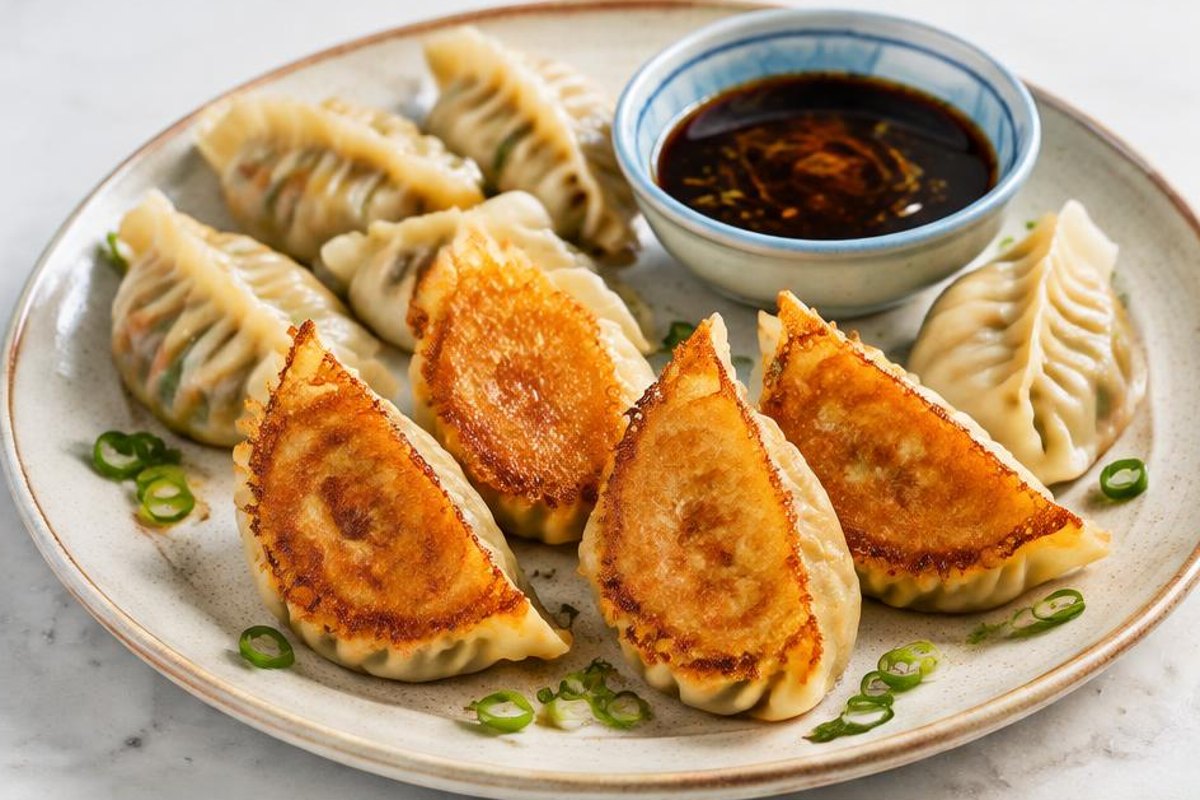
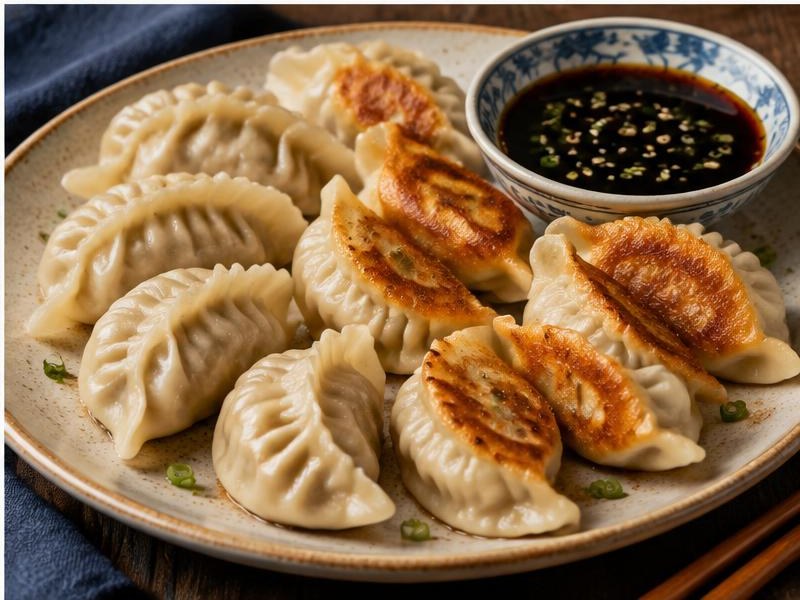
Jiaozi are crescent-shaped Chinese dumplings made from a wheat-flour wrapper and a filling, then boiled, steamed, or pan-fried. The word “dumpling” covers many foods across China and beyond; jiaozi are one family, not a universal template. Regional and household versions differ in wrapper thickness, filling, shape, and seasoning. In northern China, wheat-based dumplings are especially familiar as a meal and as a food for shared occasions. The recipe below is a home-kitchen pork-and-cabbage version designed to teach the underlying mechanics rather than claim a single canonical filling.
The most useful lesson is that dumplings are a system. Dough hydration determines whether the wrapper rolls smoothly. Salt and mixing determine whether the meat filling binds and stays juicy. Cabbage has to be salted and squeezed so it seasons the filling without flooding it. Pleating is mostly controlled sealing. Cooking method changes the wrapper texture, not the identity of the filling.
What makes a dumpling hold together?
A dumpling has two interfaces: the dough must seal to itself, and the wrapper must survive contact with hot water, steam, or oil. A fresh wheat wrapper can be supple enough to pleat yet sturdy enough to contain filling. Dough that is too dry cracks at the edge; dough that is too wet sticks, stretches, and tears. Resting allows flour to hydrate and gluten to relax, making the dough easier to roll.
Inside, the filling needs enough moisture to taste juicy but not so much that it leaks. Salt dissolves some muscle proteins in ground pork, allowing them to bind into a cohesive filling as it is mixed. Too little mixing gives a loose filling that can crumble. Excessive mixing can make the texture springy and dense. The aim is a tacky, cohesive mixture that still feels tender. A measured amount of cold water or stock can be beaten in gradually to increase juiciness; cabbage must be drained well so its liquid does not overwhelm the wrapper.
Yield and ingredients
Makes approximately 36–40 medium dumplings, depending on wrapper size.
Dough
- 300 g all-purpose flour, plus a little for dusting
- 155–170 g just-boiled water for a hot-water dough, added gradually
- ¼ teaspoon fine salt, optional
Hot water partially gelatinizes some starch and produces a tender, pliable dough useful for pan-fried or steamed dumplings. For a firmer, more elastic wrapper, use room-temperature water instead. Both approaches are common; the hot-water method here is intentionally beginner-friendly. Flour absorbs water differently, so do not pour in the whole amount at once.
Filling
- 350 g ground pork, ideally about 20–25% fat
- 250 g Napa cabbage, finely chopped
- ¾ teaspoon fine salt for the cabbage, plus ½ teaspoon for the pork mixture
- 2 scallions, finely sliced
- 1 tablespoon finely grated fresh ginger
- 1 tablespoon light soy sauce
- 1 teaspoon Shaoxing wine, optional
- 1 teaspoon toasted sesame oil
- ¼ teaspoon ground white pepper
- 2–4 tablespoons cold water or unsalted stock, as needed
Simple dipping sauce
- 2 tablespoons Chinese black vinegar or rice vinegar
- 1 tablespoon light soy sauce
- Optional: sliced scallion, a few drops of chile oil, or finely julienned ginger
Avoid making the dipping sauce so strong that it obscures the filling. Start with vinegar and soy in a 2:1 ratio and adjust to taste.
Make the wrapper dough
1. Hydrate gradually
Place the flour in a large bowl. If using salt, mix it through. Pour in about 155 g hot water in a thin stream while stirring with chopsticks or a fork. The mixture should form shaggy flakes rather than a smooth batter. If dry flour remains at the bottom, add water one teaspoon at a time. Stop when you can squeeze a handful and it clumps without feeling wet or sticky.
Water close to boiling is hot enough to be uncomfortable. Use a spoon or chopsticks to mix first; do not plunge your hand into the bowl. Once the dough is cool enough to handle, bring the flakes together and knead.
2. Knead and rest
Knead for about 6–8 minutes, pressing the dough forward with the heel of your hand, folding it back, and rotating. At first it may look rough; with kneading it should become cohesive and relatively smooth. A few small dimples are fine. If it cracks at the edges, knead in a few drops of water. If it sticks to the board, dust the board lightly rather than adding a large amount of flour to the dough.
Cover the dough and rest it for 30–45 minutes at room temperature. Resting is not optional busywork: it lets moisture distribute and relaxes the gluten network so the dough rolls without snapping back. Keep the dough covered throughout the process; exposed dough skins over and makes wrappers hard to seal.
Prepare a juicy filling without watery cabbage
1. Salt and drain the cabbage
Finely chop the Napa cabbage. Sprinkle with ¾ teaspoon salt, toss, and leave for 10–15 minutes. The salt draws moisture from the cabbage. Squeeze it firmly in a clean towel or with your hands until it is damp but no longer dripping. Do not discard all the moisture in the filling later; this step removes excess free water, not flavor.
2. Build a cohesive pork mixture
In a bowl, combine pork, the remaining ½ teaspoon salt, soy sauce, Shaoxing wine if using, white pepper, ginger, and sesame oil. Stir in one direction for about 1 minute, until the mixture looks slightly sticky. Add cold water or stock one tablespoon at a time, beating until absorbed before adding the next. Stop when the mixture is moist and cohesive but not sloshy. Depending on the pork, you may need only 2 tablespoons.
Fold in drained cabbage and scallions. Do not keep mixing for several minutes after the vegetables are incorporated. Cook a teaspoon of filling in a pan and taste it before wrapping the whole batch. Adjust salt or ginger now; raw filling is not safe to taste.
Why fatty pork matters
Very lean pork can turn dry because the filling is cooked inside a thin wrapper. A moderate amount of fat lubricates the filling and carries aroma. If the only available pork is lean, add a tablespoon of neutral oil or use a little more cold stock, but do not compensate by making the filling wet. Serious Eats explains how fatty pork and cabbage contribute to juicy, tender dumpling filling in its pork-and-cabbage guotie recipe.
Roll wrappers by hand
1. Portion the dough
Cut the rested dough into two pieces and keep one covered. Roll the other into a rope about 2 cm thick. Cut it into 18–20 equal pieces. Flatten each piece into a disk with your palm. Lightly dust the board and rolling pin.
2. Roll a round wrapper
Roll each disk from the edge toward the center, rotating the dough as you go. This creates a round wrapper with a slightly thicker center and thinner rim. The thicker center supports the filling; the thinner edge seals without becoming bulky. Aim for a 8–9 cm circle and a thickness around 1–1.5 mm. Exact dimensions are less important than consistency.
If the dough springs back, cover and let it rest for another 10 minutes. If the wrapper sticks, use a minimal dusting of flour. Too much loose flour on the edge can prevent sealing; brush it away before filling.
3. Work in small batches
Roll 4–6 wrappers at a time and fill them before the surface dries. Keep unused dough and finished wrappers under a barely damp towel. A stack of wrappers can stick together if they are wet, so separate them with a very light dusting of flour if needed.
Fill and pleat: reliable sealing beats decorative pleats
Place one wrapper in your non-dominant palm. Add about 1 level tablespoon of filling, roughly 12–14 g, to the center. Leave a clear border all around. Dip a fingertip in water and moisten only half of the rim if the dough feels dry.
Fold the wrapper in half over the filling to make a half-moon. Press the center point together first, then seal from the center toward one end and then the other, pushing out trapped air as you go. Air pockets can expand and split the dumpling during cooking.
For a simple pleat, hold the dumpling in one hand. With the other, make two or three small folds on the front edge, pressing each fold firmly against the flat back edge. The back can remain smooth. Or simply press the two edges together without pleats. A plain, well-sealed dumpling is better than a beautiful one with a leak.
Inspect the seam. It should be closed with no visible filling or flour trapped between the layers. Place each finished dumpling on a lightly floured tray with the seam upright. Cover while you finish the rest. If the tray is crowded, leave a little space so damp wrappers do not fuse together.
Choose the cooking method
Jiaozi can be boiled, steamed, or pan-fried. The best method depends on the texture you want and the equipment available. For crisp-bottom dumplings, see the site’s dedicated guotie potsticker guide; the method below gives a pan-fried shortcut while emphasizing that guotie and boiled jiaozi are related preparations rather than interchangeable names in every context.
Boiling: tender, slippery wrappers
Bring a large pot of water to a steady boil. Add dumplings in batches, leaving room for them to move. Stir gently once with a slotted spoon to prevent sticking to the bottom. When the water returns to a boil, add about ½ cup cold water and let it return to a boil again. Repeat once if needed, until the wrappers are translucent and the dumplings float and look plump. With medium dumplings, this generally takes several minutes after the water returns to the boil; do not rely on floating alone as a guarantee that a raw meat center is cooked.
Cut one dumpling open if uncertain: the pork should be cooked through with no raw-looking center. A thermometer inserted into the filling can confirm a safe internal temperature; for ground pork, follow the food-safety temperature guidance applicable in your country. Remove with a slotted spoon and serve promptly.
Steaming: soft, slightly chewy wrappers
Line a bamboo or metal steamer with cabbage leaves, parchment with holes, or a lightly oiled liner. Leave space between dumplings; they expand slightly and may stick together. Bring the water beneath the rack to a steady simmer. Steam fresh dumplings for approximately 8–10 minutes, adjusting for size and wrapper thickness. Check a dumpling in the first batch rather than assuming the same timing for all equipment.
Pan-frying: browned base, tender top
Heat a tablespoon of neutral oil in a nonstick or well-seasoned skillet over medium heat. Place dumplings flat-side down in one layer and cook until the bottoms turn pale gold, about 2 minutes. Carefully add 80–100 ml water and cover immediately. Steam until the water has mostly evaporated and the filling is cooked through, about 5–7 minutes depending on size. Remove the lid and let the bottoms crisp again for 1–2 minutes.
Do not pour water into a pan that is smoking hot or stand over it while adding water; hot oil can spatter. Lower the heat first if necessary, add water away from your body, and cover promptly. If the dumplings stick, give them another moment after the water evaporates; a crisp base often releases more cleanly once it has browned.
Freezing and cooking from frozen
Freeze uncooked dumplings in a single layer on a tray until firm, then transfer them to a sealed freezer bag. This prevents them sticking into a solid mass. Label the date. Cook from frozen without thawing, allowing additional time. For boiling, add frozen dumplings to boiling water and use gentle stirring; replenish with cold water as needed, then verify the filling is cooked. For pan-frying, brown the base, add a little more water than for fresh dumplings, cover, and cook longer over moderate heat. Avoid overcrowding the pan, which lowers the temperature and encourages sticking.
Cooked leftovers should be cooled and refrigerated promptly in a covered container. Reheat until steaming hot throughout. The safest approach is to follow local food-safety guidance and not leave cooked dumplings at room temperature for extended periods.
Troubleshooting
The dough cracks when folded
It may be too dry, insufficiently rested, or exposed to air. Knead in a few drops of water, cover it, and rest again. Keep wrappers covered while assembling.
The dough is sticky and difficult to roll
Dust the board and pin lightly, and let the dough rest. If the dough is very wet, knead in small amounts of flour. Avoid adding a lot at once, which can make the wrapper tough.
Dumplings open during boiling
Common causes include overfilling, a dry or floury rim, trapped air, or a weak seam. Use less filling, moisten the edge sparingly, press the center first, and push air out toward the ends as you seal.
The filling is dense
It may be too lean, overmixed, or lacking moisture. Use pork with moderate fat, beat in cold stock gradually, and stop mixing once cohesive. Cabbage should be squeezed but not rendered completely dry.
The filling tastes bland
Salt the filling accurately and cook a small sample to taste before wrapping. Add ginger, scallion, soy, or white pepper in measured increments. Dipping sauce helps, but it should not have to rescue an underseasoned center.
Wrappers are gummy
They may be too thick, undercooked, or packed too tightly in the pot. Roll more evenly, cook in smaller batches, and wait for the water to return to a boil between additions.
Dipping sauce and serving
Start with black vinegar and light soy sauce, then add ginger or chile oil if you like. Garlic is a common preference in some homes, though it is not necessary. Serve dumplings immediately while the wrapper is supple. A plate of dumplings can be a complete meal with a vegetable side, or one part of a larger table that includes mapo tofu and rice. For a different Chinese dumpling tradition and a clear comparison of thin wrappers and soup, browse the Cantonese wonton noodle soup guide.
Frequently asked questions
Are jiaozi the same as potstickers?
“Potsticker” is the English name commonly used for pan-fried Chinese dumplings, often referring to guotie. Jiaozi is a broader Chinese dumpling family that may be boiled, steamed, or pan-fried. In everyday usage the categories can overlap, but cooking method and regional naming matter. This guide uses jiaozi for the general dumpling and points to the guotie article for a dedicated crisp-bottom treatment.
Can I use store-bought wrappers?
Yes. Round wheat dumpling wrappers save time and work well. Keep them covered so the edges do not dry. They may be thinner or less elastic than homemade wrappers; use slightly less filling and moisten the edge if needed. Avoid wonton wrappers for this recipe unless you specifically want a thinner, square wrapper and are comfortable adapting the fold.
Can the filling be made ahead?
It can be mixed a few hours ahead and kept covered and refrigerated. For best wrapper texture, assemble close to cooking. If the salted cabbage sits in the pork mixture for a long time, it may release more liquid, so drain it thoroughly and keep the filling cold.
Do I need to add an egg to the filling?
No. Egg is not required for this pork-and-cabbage filling. The salt and mixing create enough cohesion when the meat is handled properly. An egg can change the texture and add moisture, so do not add it automatically.
Can I make vegetarian jiaozi with this dough?
Yes. Use a filling with controlled moisture: cooked and thoroughly drained mushrooms, tofu, chives, cabbage, or other vegetables. Cool cooked ingredients before wrapping. Vegetarian fillings vary substantially; do not substitute equal volumes of vegetables into the pork formula without adjusting moisture and seasoning.
A useful benchmark
A successful homemade jiaozi has a wrapper that is tender but not waterlogged, a seam that stays shut, and a filling that tastes seasoned on its own. You do not need perfect pleats. Work cleanly, keep dough covered, drain cabbage, and test one dumpling before cooking the whole batch. The rest is practice and a good meal shared at the table.