Cultural Provenance: The Legend of Mrs. Chen’s Pockmarked Face
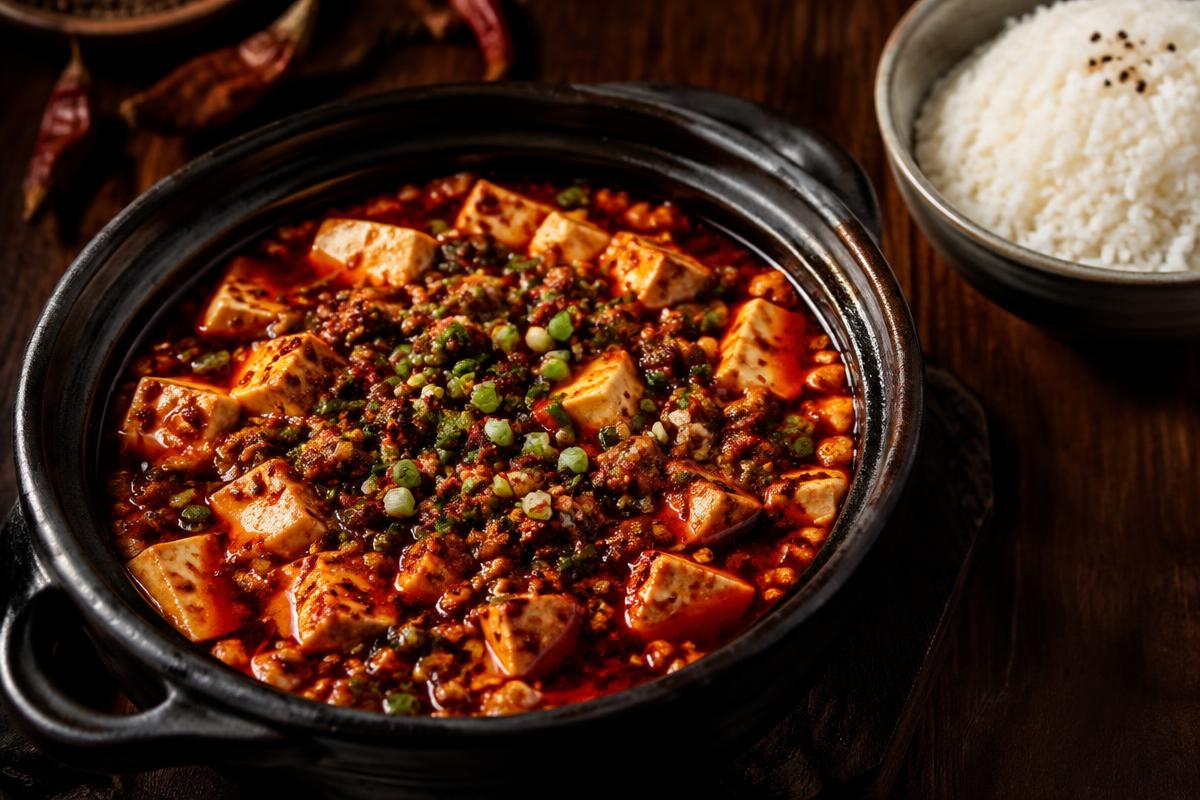
Mapo Tofu is one of the crown jewels of Sichuan cuisine (Chuan Cai), recognized globally as the ultimate embodiment of Málà (麻辣)—the mind-bending intersection of tingly, numbing heat and fiery chili sharpness.
The dish emerged during the late Qing Dynasty (circa 1862) on the outskirts of Chengdu, Sichuan's capital. Near the Wanfu Bridge, porters and laborers carrying jars of fresh cooking oil and goods into the city needed cheap, high-protein sustenance. A woman named Mrs. Chen—known colloquially as Chen Mapo ("Pockmarked Old Woman Chen," referring to childhood smallpox scars on her face)—ran a humble roadside tavern.
When porters gifted her fresh cooking oil, tofu curds, and a few scraps of beef, she combined them in a blazing-hot cast-iron wok with fermented chili bean paste (Pixian Doubanjiang), fermented black beans, and wild Sichuan peppercorns. The dish became so famous that her restaurant, Chen Mapo Doufu, became an official landmark in Chengdu culinary history.
In Sichuan culinary doctrine, an authentic Mapo Tofu is not simply judged on heat; it must satisfy the Eight Sacred Qualities of Mapo Tofu (麻婆豆腐八字诀):
- Mǎ (麻): Numbing sensation from freshly ground tribute Sichuan peppercorns.
- Là (辣): Pungent, penetrating heat from Sichuan chili powders and fermented pastes.
- Tàng (烫): Scalding thermal heat, sealed beneath a glossy, red chili-oil sheen that keeps the tofu volcanic until the final bite.
- Xiān (鲜): Savory umami depth, coaxed from fermented beans and superior broth.
- Nèn (嫩): Tender, custard-like tofu texture that trembles without collapsing.
- Xiāng (香): Aromatic fragrance of wok-bloomed garlic, ginger, and scallions.
- Suì (酥): Crispy, brittle beef mince (niurou su), fried until dehydrated and nutty.
- Huó (活): Visual vitality—the tofu blocks must stand distinct in a vibrant, jewel-red sauce, never broken into sludge.
The Molecular Science of Málà & Tofu Dynamics
1. The Neurobiology of Hydroxy-alpha-sanshool vs. Capsaicin
Western palates often conflate spiciness with heat, but Mapo Tofu operates on two distinct neurological pathways:
- Capsaicin (Là): The chemical compound in red chiles binds directly to the TRPV1 receptor on pain-sensing sensory neurons, the same receptor activated by temperatures above 109°F (43°C). The brain perceives this as a burning chemical fire.
- Hydroxy-alpha-sanshool (Mǎ): The active compound in Sichuan peppercorns (Zanthoxylum) does not activate thermal receptors; it activates tactile mechanoreceptors (specifically RA1 and AM tactile fibers) on the tongue and lips. It vibrates the cellular nerves at a frequency of approximately 50 Hertz, producing a physiological sensation of vibration, physical numbness, and localized paresthesia. Furthermore, sanshool stimulates salivary secretion, unlocking dormant flavor compounds in the fermented soybean paste.
2. The Saline Blanching Protocol (Why Most Home Tofu Fails)
The most common mistake home cooks commit is dropping cold, raw tofu directly into the stir-fry sauce. This results in watery, bland tofu that breaks into fragments during stirring.
- Osmotic Dehydration: Tofu is an emulsion of soy milk proteins (primarily glycinin and conglycinin) coagulated with calcium sulfate or magnesium chloride, trapping up to 85% water within a porous protein lattice.
- The Saline Bath: By simmering cut tofu cubes for 3 to 5 minutes in lightly salted water (1 teaspoon salt per 2 cups water) just below boiling point (195°F–200°F / 90°C–93°C):
- Osmotic pressure draws out excess internal free water.
- The hot water causes the protein matrix to tighten and set, rendering the tofu supple and elastic so it can survive being pushed with a wok spatula.
- The tofu is brought to the exact internal temperature of the sauce, preventing it from cooling down the wok later.
3. The Three-Stage Starch Addition (Sān Cì Gōu Qiàn 三次勾芡)
A restaurant-grade Mapo Tofu sauce must cling to each tofu cube like liquid silk without weeping liquid into the bottom of the bowl. Professional Sichuan chefs achieve this through three successive additions of potato starch slurry:
- Stage 1: Thickens the base broth and coats the beef granules.
- Stage 2: Coats the hot tofu cubes as they absorb the chili oil.
- Stage 3: Locks in the emulsion, stabilizing the sauce so the chili oil separates slightly to the surface to form the insulating Tàng lid.
Deep Ingredient Anatomy & Sourcing
1. The Soul of Sichuan: Pixian Doubanjiang (郫县豆瓣酱)
You cannot make authentic Mapo Tofu with generic supermarket chili paste or sweet Korean gochujang. You require authentic Pixian Doubanjiang from the town of Pixian (now Pidu District) in Sichuan.
- Made from broad beans (fava beans), Erjingtiao chiles, wheat flour, and salt.
- Aged in earthenware urns open to natural sunshine and stirred daily for a minimum of 1 to 3 years.
- Grade: Look for Juan Cheng Brand (鹃城牌) 3-Year Aged Pixian Doubanjiang. It has an ink-dark reddish-brown color, a profound savory funk, and zero artificial sweetness. Finely mince it on your cutting board before cooking to release its trapped pigments.
2. The Black Gold: Fermented Black Soybeans (Douchi 豆豉)
Whole black soybeans fermented with Aspergillus mold and salt. Look for Sichuan or Yangjiang douchi. Rinse lightly in cold water to remove surface grit, then finely mince alongside the Doubanjiang.
3. The Meat: Beef vs. Pork
While modern American-Chinese takeout often uses ground pork, historical Chen Mapo Tofu exclusively uses beef—specifically flank steak or chuck, hand-minced into small 1/4-inch beads. Beef provides deep iron notes that stand up to the robust fermented paste.
4. The Peppercorns: Hanyuan Red Sichuan Peppercorns
Tribute-grade red Sichuan peppercorns from Hanyuan county. Toast them gently in a dry wok over low heat until oils shimmer, cool them completely, and crush them in a mortar and pestle to an ultra-fine powder just before cooking.
Complete Ingredient Roster
- Tofu & Blanching Base:
- 1 lb (450 g) medium-firm or tender water tofu (Nen Doufu, do not use chalky extra-firm tofu or fragile dessert silken tofu)
- 4 cups water + 1 teaspoon fine sea salt
- Meat & Searing Base:
- 4 oz (115 g) lean beef chuck or flank steak, hand-chopped into fine 1/4-inch gravel
- 2 tablespoons pure peanut oil or Sichuan rapeseed oil (Caizi You)
- 1 teaspoon light soy sauce
- Aromatics & Fermented Pastes:
- 2.5 tablespoons Juan Cheng 3-Year Pixian Doubanjiang, finely minced
- 1 tablespoon Sichuan fermented black beans (Douchi), rinsed and minced
- 1.5 tablespoons Sichuan chili powder (preferably stone-ground Erjingtiao or Chaotian chili flakes)
- 3 cloves garlic, finely minced
- 1 tablespoon fresh ginger, peeled and finely minced
- 3 scallions, white parts finely sliced into rounds (for the sauce), green parts cut into 1-inch batons (for the finish)
- 1 cup unsalted rich chicken stock or supreme broth
- 1 teaspoon Shaoxing cooking wine
- 1/2 teaspoon white sugar (balances the fermented saltiness)
- 1/2 teaspoon light soy sauce
- The Thickening Slurry:
- 1.5 tablespoons potato starch (or cornstarch) dissolved in 3 tablespoons cold water
- The Finish:
- 1.5 tablespoons roasted Sichuan chili oil (red oil)
- 1 teaspoon freshly toasted, finely ground Hanyuan Sichuan peppercorn powder
Step-by-Step Master Method
Step 1: Prep and Saline Blanching of the Tofu
- Cut the tofu block into uniform 3/4-inch (2 cm) cubes.
- In a saucepan, bring the 4 cups of water and 1 teaspoon salt to a bare simmer (around 195°F / 90°C).
- Gently slide the tofu cubes into the salted water. Simmer gently over medium-low heat for 3 to 4 minutes. Do not allow the water to roll into a rapid boil.
- Keep the tofu in the warm water on the lowest heat setting while you prepare the wok. (Draining it beforehand causes the cubes to stick together and cool down).
Step 2: Frying the Beef Mince (Su)
- Heat a traditional carbon steel wok over high heat until wisps of white smoke emerge. Swirl in 2 tablespoons of peanut oil to coat the walls (Long You).
- Add the hand-chopped beef. Immediately drop heat to medium. Break up the beef with your wok spatula.
- Fry steadily for 3 to 4 minutes until the moisture completely evaporates. The beef will crackle and turn from soft pink to a deeply browned, crispy gravel texture (Su).
- Splash in 1 teaspoon Shaoxing wine and 1 teaspoon light soy sauce. Stir-fry for 30 seconds until aromatic, then push the beef to the perimeter of the wok or remove to a small plate.
Step 3: Blooming the Fermented Pastes & Aromatics
- Lower wok heat to low. Add the minced Pixian Doubanjiang and minced fermented black beans into the center of the residual oil.
- Slowly fry the pastes over low heat for 1 to 2 minutes, constantly stirring with the spatula. Sensory Cue: The oil will transform from clear to a brilliant, glowing ruby-red hue, and the harsh raw smell of fermented beans will sweeten into a rich, roasted aroma.
- Add the Sichuan chili powder, minced garlic, and minced ginger. Fry for 30 seconds until fragrant. Do not burn the garlic.
Step 4: Braising the Tofu
- Pour in the 1 cup of chicken stock. Add 1/2 teaspoon sugar and 1/2 teaspoon light soy sauce. Increase heat to high and bring the red sauce to a vigorous boil.
- Using a slotted spider skimmer, gently lift the hot tofu cubes from their warm water bath, letting excess water drain off for two seconds, and slide them directly into the bubbling sauce.
- Re-incorporate the crispy beef mince.
- Lower the heat to medium. Simmer the tofu in the sauce for 3 to 4 minutes, allowing the porous bean curds to absorb the chili broth.
- Technique Note: Never stir Mapo Tofu with the sharp edge of a spatula. Instead, hold the back of the wok ladle flat against the bottom of the wok and gently push the sauce and tofu in a clockwise motion, keeping the cubes intact.
Step 5: The Three-Stage Slurry (Sān Cì Gōu Qiàn)
- Re-stir your potato starch slurry to ensure the starch has not settled at the bottom of the bowl.
- First Addition: Drizzle one-third of the slurry around the outer bubbling perimeter of the sauce. Gently push with the back of the ladle. The sauce will begin to lightly thicken. Simmer for 30 seconds.
- Second Addition: Drizzle another third of the slurry. Push gently. Notice how the sauce now begins to cling directly to the faces of each tofu cube. Simmer for 30 seconds.
- Third Addition: Add the green scallion batons. Drizzle the final portion of slurry. The sauce will tighten into a glossy, velvety lacquer, and the red oil will begin to naturally separate around the edges of the pan.
- Swirl the 1.5 tablespoons of roasted chili oil around the rim of the wok. Turn off the heat.
Step 6: Plating & The Volcanic Finish
- Slide the contents of the wok gently into a shallow ceramic serving bowl.
- Immediately shower the entire surface with the freshly ground Hanyuan Sichuan peppercorn powder. The rising steam will activate the volatile oils of the peppercorns, filling the dining room with a fragrant citrus-electric cloud. Serve scalding hot with abundant bowls of steamed Jasmine rice.
Crucial Kitchen Errors & Troubleshooting Matrix
| Issue | Food Science Failure Point | How to Salvage Current Dish | Future Batch Prevention |
|---|---|---|---|
| Tofu broke into crumbled mess | Vigorous boiling or using a sharp spatula edge to chop through cubes. | Serve over rice as a rustic homestyle Mapo hash. | Use medium-firm water tofu, perform the saline blanch, and push only with the rounded back of the ladle. |
| Sauce turned watery after 5 minutes at the table | Amylase enzymes in saliva/spoons broke down undercooked starch, or single heavy starch addition wept liquid. | Stir back into a clean saucepan, bring to a rapid 1-minute boil, and re-thicken with fresh slurry. | Add slurry in 3 measured stages, allowing each stage to cook for 30 seconds to fully gelatinize starches. |
| Bitter, astringent flavor profile | Pixian Doubanjiang or Sichuan chili flakes were scorched over excessive heat. | Add 1/4 teaspoon sugar and an extra splash of rich chicken stock to round out edges. | Bloom fermented pastes strictly over medium-low heat until the oil turns translucent red. |
| Lacks authentic numbing kick (Mǎ) | Supermarket pre-ground peppercorns used, which lost their volatile sanshool oils months ago. | Toast whole peppercorns in a skillet, grind in a mortar, and dust heavily over the top. | Grind freshly toasted whole Hanyuan red peppercorns immediately before serving. |