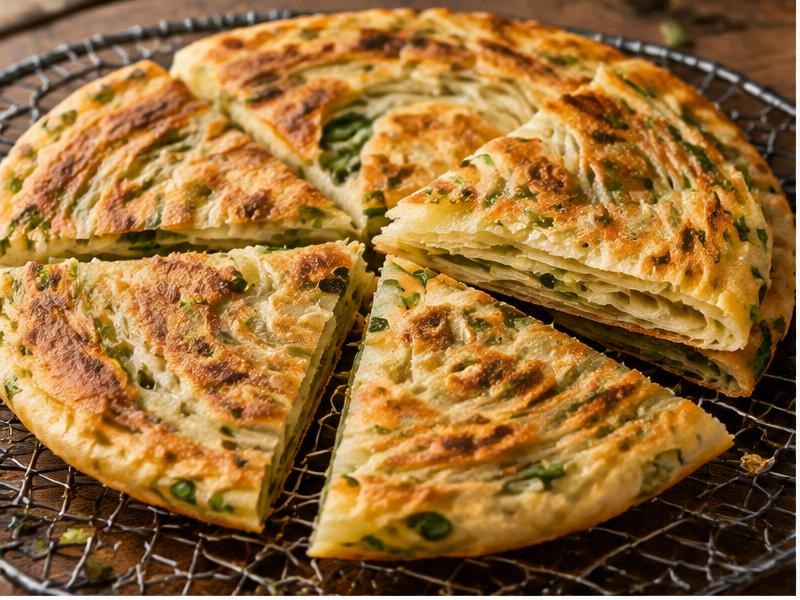
Cong You Bing (葱油饼) is the crown jewel of northern Chinese street food and wheat cookery. A masterfully executed scallion pancake is a masterclass in textural contrast: shatteringly crisp and blistered on the exterior, yielding into dozens of tender, savory, onion-perfumed laminated layers on the interior.
Yet home cooks attempting this dish frequently produce leaden, dense, rubbery disks that snap back against the rolling pin and chew like tough cardboard. The secret to an authentic scallion pancake is not brute kneading force. It lies in two precise pastry techniques: hot-water dough gelatinization (tàngmiàn, 烫面) to control gluten tension, and laminated oil-flour paste (yǒusū, 油酥) to physically separate micro-sheets of dough.
The Chemistry of Scalded Dough and Lamination
In Western laminated pastry like croissants or puff pastry, butter is kept cold so solid fat sheets physically separate cold flour layers during baking. Unleavened Chinese flatbreads achieve similar multi-layered flakiness in a flat skillet without butter or yeast by manipulating wheat flour and hot fat.
1. The Hot-Water Starch Transformation (Tàngmiàn)
Wheat flour contains two key structural components: gluten-forming proteins (gliadin and glutenin) and starch granules.
- When flour is mixed with cold water, gliadin and glutenin hydrate and link into long, highly elastic gluten chains. This elasticity is ideal for chewy hand-pulled noodles or crusty bread, but disastrous for flatbreads: the dough snaps back aggressively when rolled, remains thick, and turns tough when fried.
- When near-boiling water (85–95°C / 185–205°F) hits wheat flour, the intense thermal energy partially denatures the proteins, blunting their ability to form rigid, cross-linked gluten matrices. At the same time, wheat starch granules absorb water rapidly and gelatinize, swelling into a soft, tender gel.
- A subsequent addition of cold water drops the dough temperature, preserving just enough gluten network to keep the dough cohesive. The result is a dough that rolls out paper-thin without tearing or springing back, frying up tender rather than tough.
2. The Laminated Oil-Flour Barrier (Yǒusū)
Simply brushing liquid oil between rolled dough sheets often fails because the oil migrates into the dough or squeezes out when pressed, fusing the layers back together. Traditional Shandong and Taiwanese street stalls use a roux-like paste called yǒusū: toasted sesame oil or rendered pork lard mixed with seasoned all-purpose flour. The suspended flour particles trap the lipid droplets, creating a stable, viscous physical barrier. When the rolled coil hits the hot skillet, moisture trapped inside each micro-sheet flashes into steam, ballooning against the oil barriers and forcing the layers to separate into delicate flakes.
The Formula and Metric Weights
Makes 4 large, restaurant-caliber pancakes (roughly 18–20 cm diameter each).
Ingredients
The Hot-Water Dough Base
- 300 g all-purpose wheat flour (approx. 10.5–11.5% protein content)
- 160 g boiling water (100°C / 212°F, fresh from the kettle)
- 50 g cold tap water (room temperature)
- 3 g fine sea salt (½ teaspoon)
The Laminated Roux Paste (Yǒusū)
- 40 g all-purpose flour
- 45 g neutral cooking oil, toasted sesame oil, or rendered lard
- 4 g fine sea salt (¾ teaspoon)
- 1 g Chinese five-spice powder or finely ground white pepper (¼ teaspoon)
The Aromatic Filling & Pan-Frying
- 120 g fresh scallions (green onions), washed, thoroughly dried, and finely sliced (use green and pale white parts)
- 60–80 g neutral high-heat oil (peanut, canola, or vegetable oil) for shallow pan-frying
Step-by-Step Culinary Protocol
Step 1: Prepare the Scalded Dough
Place the 300 g flour and 3 g salt in a heatproof mixing bowl or the bowl of a stand mixer. Pour the 160 g of boiling water directly over the flour in a steady stream, stirring rapidly with a pair of wooden chopsticks or a fork. The flour will form shaggy, ragged, pale yellow clumps as the starch gelatinizes.
Immediately pour in the 50 g of cold tap water and continue stirring until a cohesive, rough mass forms. Once the dough is cool enough to handle safely (about 2 minutes), turn it onto a clean work surface and knead by hand for 3 to 4 minutes. It will initially feel slightly sticky, but will quickly smooth out into a soft, pliable, yielding dough.
Shape the dough into a smooth ball, return it to the bowl, and cover tightly with plastic wrap or a damp towel. Rest the dough at room temperature for at least 30 to 45 minutes. This resting period allows remaining starches to hydrate fully and relaxes any remaining gluten tension.
Step 2: Whisk the Laminated Roux (Yǒusū)
While the dough rests, combine 40 g flour, 4 g salt, and five-spice powder in a small heatproof bowl.
Heat the 45 g of oil or lard in a small saucepan until it shimmers (roughly 160°C / 320°F). Pour the hot oil directly over the seasoned flour. It will sizzle vigorously, toasting the flour and blooming the spices. Whisk thoroughly with a fork until smooth. Let cool to room temperature; it will thicken into a spreadable paste resembling runny nut butter.
Crucial prep note on scallions: Chop the scallions and spread them across paper towels to ensure they are bone-dry. Wet scallions weep moisture, steam inside the pastry, and cause the laminated sheets to tear during rolling.
Step 3: Roll, Laminate, and Coil
Divide the rested dough into 4 equal portions (roughly 125–130 g each). Keep unused portions covered under plastic wrap.
- Lightly oil your work surface and rolling pin with a drop of neutral oil (avoid heavy flour dusting, which dries out the dough and burns in the pan).
- Take one dough ball and roll it into a large, paper-thin rectangle, approximately 25 × 35 cm (10 × 14 inches). The dough should be thin enough that the outline of your countertop is faintly visible beneath it.
- Spoon one-quarter of the oil paste (yǒusū) across the dough. Using your fingers or a pastry brush, spread the paste in an ultra-thin, uniform sheen across the entire surface, leaving a 1 cm clean border at the edges.
- Scatter one-quarter of the dry, chopped scallions (about 30 g) evenly across the oiled surface.
- Starting from the long edge nearest you, roll the dough tightly forward into a long, slender cylinder or rope. Gently pull outward as you roll to elongate the cylinder and ensure no air pockets remain trapped.
- Twist the dough rope gently along its axis to seal the seam. Then, coil the rope tightly around itself in a flat, concentric spiral—like a snail shell. Tuck the final tail of the rope neatly underneath the center of the coil and press down gently with the palm of your hand.
- Repeat with the remaining 3 dough portions. Cover all 4 coils with plastic wrap and rest for an additional 15 minutes. Attempting to roll the coils immediately will burst the layers because the gluten is stretched tight.
Step 4: The Final Flattening
Take one rested coil. Using a rolling pin, roll gently from the center outward, rotating the disk 45 degrees after each stroke to maintain a circular shape. Roll until the pancake is roughly 18–20 cm (7–8 inches) in diameter and 4–5 mm (about 3/16 inch) thick.
Some scallions may press visibly against the surface or poke through slightly; this is normal and creates caramelized crispy edges in the pan.
Step 5: Shallow Pan-Frying Thermodynamics
To achieve authentic street-stall shatter without greasy heaviness, the pancake must be shallow-fried, not dry-toasted.
- Heat 1.5 to 2 tablespoons (20–25 g) of neutral oil in a heavy cast-iron skillet or nonstick pan over medium heat until it registers 175°C (350°F). The oil should ripple and shimmer across the pan.
- Carefully lay the rolled pancake into the hot oil. It should immediately sizzle gently around the perimeter.
- Cover the skillet with a lid for the first 60 seconds. Trapping the steam forces the water inside the dough layers to vaporize and expand, puffing the laminated interior.
- Remove the lid. Fry uncovered for another 60 to 90 seconds, swirling the pancake gently in the oil to ensure uniform browning. The bottom should be deep golden, stiff, and blistered with crisp rings.
- Flip the pancake. Fry uncovered for 2 to 3 minutes, pressing down gently with a spatula to ensure even contact with the hot oil.
- The Fluffing Clap: Transfer the cooked pancake to a wire rack. Immediately use two spatulas (or tongs) to push the edges of the pancake inward toward the center, crushing it gently in 3 or 4 rapid motions. This impact fractures the brittle exterior crust and releases trapped steam, separating the internal laminated flakes so they become visibly layered.
Cut into wedges with a sharp chef's knife or pizza wheel and serve hot.
Troubleshooting Common Failures
The pancake is tough, rubbery, and dense.
Causes: Dough was mixed with cold or lukewarm water, kneaded excessively, or rolled out without resting.
Correction: Use truly boiling water (100°C) straight from the kettle for the initial flour scalding to denature gluten proteins. Always allow the dough coils to rest for 15 minutes before rolling them flat.
The dough tears and leaks scallions and oil everywhere while rolling.
Causes: Scallions were wet when applied, or the coiled dough was rolled too aggressively without a rest.
Correction: Dry chopped scallions thoroughly on paper towels. Roll gently from the center outward with light pressure rather than pressing down hard.
The pancake is pale, soggy, and greasy.
Causes: Pan oil was too cold, or the pancake sat in low heat too long.
Correction: Ensure the oil reaches 175°C (350°F) before adding the dough. The pancake must sizzle actively on contact to seal the outer crust and prevent excessive oil absorption.
The outside burns before the inside cooks through.
Causes: Pan heat was too high, or the pancake was rolled too thick (over 6 mm).
Correction: Lower the flame to medium, cover with a lid for the first minute to steam-cook the interior, and ensure pancakes are rolled to an even 4–5 mm thickness.
Make-Ahead and Freezing Protocol
Uncooked scallion pancakes are ideal for freezing:
- Roll out the pancakes completely between sheets of parchment paper or plastic wrap.
- Stack them flat on a baking sheet and freeze solid for 2 hours.
- Transfer frozen rounds to a large airtight freezer bag, keeping parchment between each pancake. They keep perfectly for up to 3 months.
- Do not thaw before cooking. Add an extra tablespoon of oil to the skillet, lay the frozen pancake directly into the hot pan, cover with a lid for 2 minutes to thaw and steam, then fry uncovered per standard instructions until crisp and golden on both sides.
How to Pair Scallion Pancakes on Faithful Food Online
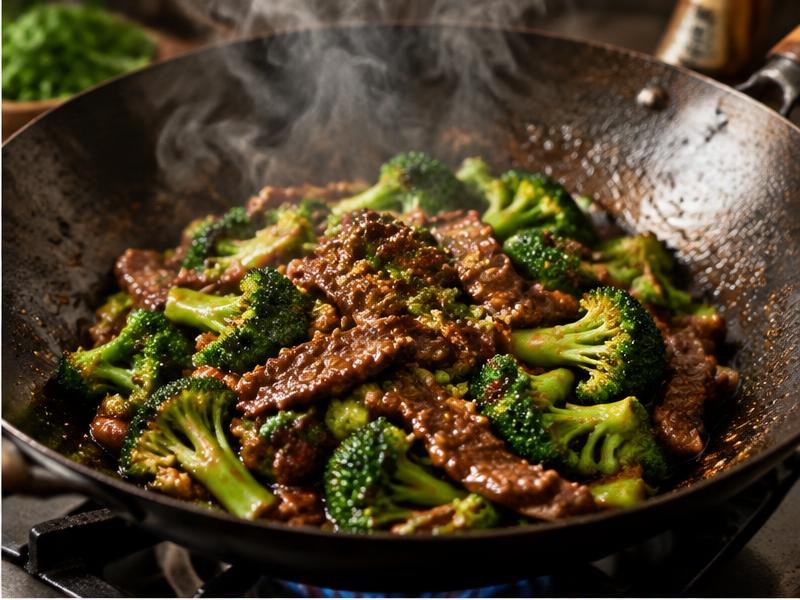
Serve warm scallion pancake wedges alongside a bowl of rich Cantonese wonton noodle soup or spicy Sichuan dan dan noodles. They make an exceptional textural accompaniment to saucy main dishes like Cantonese sweet and sour pork and our restaurant-style Chinese beef stir-fry.