Cultural Provenance: From Lebanese Shawarma to Mexico City Night Markets
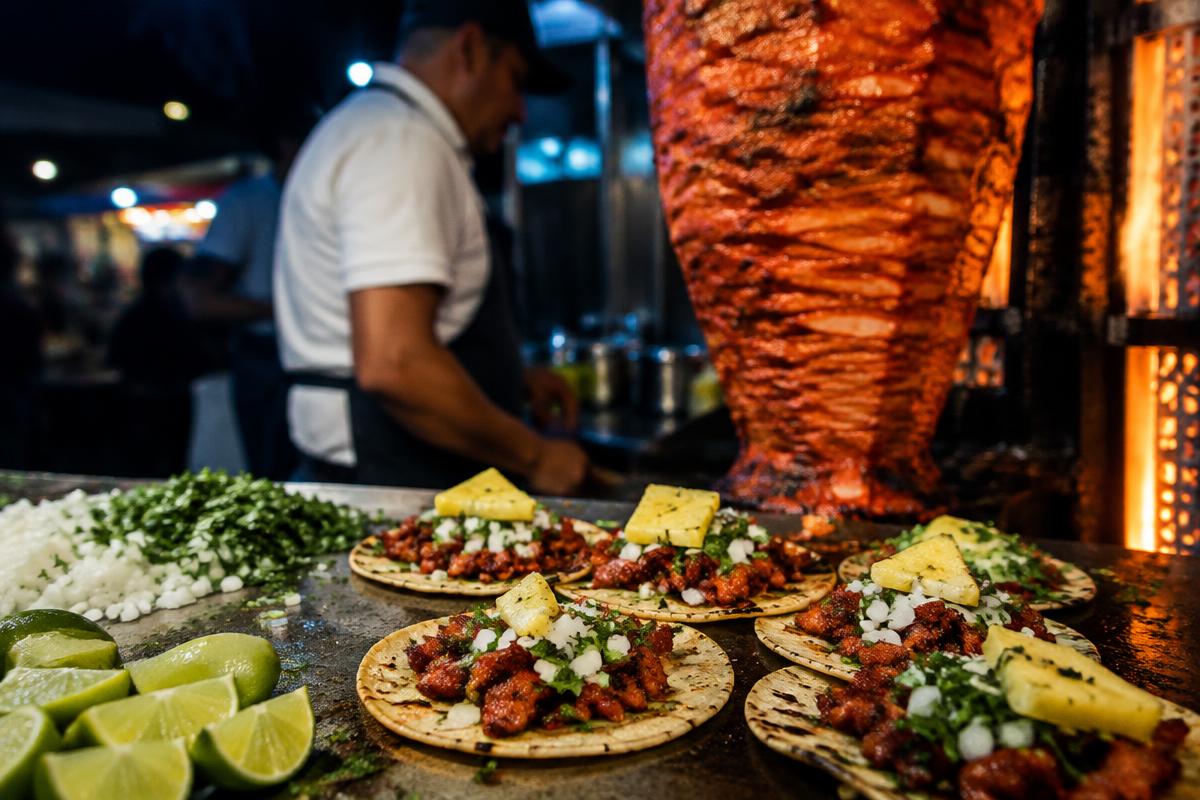
In the vibrant tapestry of Mexico City street gastronomy, no aroma is more mesmerizing than that of a glowing, vertical rotisserie (trompo) spinning in the open evening air, crowned with a peeled pineapple and shaved by a nimble taquero into warm corn tortillas.
The origin of Tacos Al Pastor ("in the style of the shepherd") is one of the most celebrated cultural fusions in culinary history. In the 1930s, Christian Lebanese immigrants arrived in the central Mexican state of Puebla, fleeing the collapse of the Ottoman Empire. They brought with them their ancestral technique of vertical spit-roasting marinated lamb on a metal skewer (shawarma), serving it in flatbreads called pan árabe (creating Tacos Árabes).
As the dish migrated west to Mexico City in the 1960s, local taqueros thoroughly Mexicanized it:
- They swapped lamb for the abundant, economical Mexican staple: pork shoulder (puerco).
- They replaced Middle Eastern spices with an indigenous adobo anchored by achiote (annatto paste), dried Mexican chiles (guajillo and ancho), and Mexican oregano.
- They crowned the rotating meat tower with a fresh pineapple (piña), whose sweet, enzymatic juices baste the roasting pork as it spins.
True Tacos Al Pastor is not just sweet pulled pork; it is a symphony of thin, deeply seasoned pork ribbons boasting crispy charred edges (chamusquitas), balanced by the fiery perfume of toasted dried chiles, warm allspice, and the juicy burst of roasted pineapple.
Culinary Physics & Food Science: Bromelain and Carotenoid Chemistry
1. The Biochemistry of Bromelain: The Pineaple Enzymatic Trap
The pairing of fresh pineapple with pork in Al Pastor is not merely a flavor contrast; it is an aggressive chemical reaction driven by bromelain.
- What is Bromelain? Fresh pineapple juice contains a mixture of cysteine endopeptidases (proteolytic enzymes). Bromelain actively hydrolyzes peptide bonds in muscle proteins (myosin and actin) and breaks down insoluble collagen into soluble peptides.
- The Danger of Over-Marination: If you marinate raw pork with fresh, unheated pineapple juice for more than 4 to 6 hours, the bromelain does not just tenderize the meat; it digests it completely, breaking the muscle fibers into an unappetizing, mushy paste with the consistency of baby food.
- The Master Culinary Fix: In our authentic formulation:
- We limit raw pineapple exposure in the marinade to a precise 4-hour window, or
- We lightly simmer the pineapple juice for 3 minutes before blending. Boiling denatures the bromelain enzyme permanently (at temperatures above 158°F / 70°C), neutralizing its protein-destroying capability while retaining 100% of its sweet, tart tropical acids.
2. The Chemistry of Achiote: Bixin Extraction
Authentic Al Pastor is instantly recognizable by its deep crimson-scarlet hue. This color comes from achiote paste, made from the ground seeds of the tropical Bixa orellana tree.
- Annatto seeds contain two primary carotenoid pigments: bixin (fat-soluble) and norbixin (water-soluble).
- Bixin dissolves poorly in plain water. To extract its vibrant red pigments and earthy, slightly peppery flavor, achiote paste must be blended with acidic vinegar and heated pork fat. The acetic acid in vinegar cleaves the pigment molecules, staining the pork deeply through the outer muscle layers.
3. Simulating the Commercial Trompo at Home
In professional taquerías, the trompo exposes the outer meat layer to intense radiant infrared heat. The taquero shaves off the cooked, crispy outer crust, exposing the raw meat underneath to roast again.
- The Skewer Tower Technique: To recreate this dynamic in a domestic oven, we thread thinly pounded, marinated pork ribbons onto heavy wooden skewers anchored into a halved onion and pineapple base, roasting it vertically at high convection heat (400°F / 200°C), followed by a flash under the broiler. This ensures direct hot air circulation around the meat, replicating the concentric roasting and crispy charred edges of a real trompo.
Deep Ingredient Anatomy & Sourcing
1. The Pork Cut: Pork Boston Butt / Pork Collar
Never use lean pork loin or tenderloin; it lacks the intramuscular fat and connective tissue needed to withstand intense radiant roasting. Use boneless pork Boston butt (pork shoulder) or well-marbled pork collar. The meat must be sliced across the grain into paper-thin cutlets (approx. 1/8-inch / 3 mm thick) and pounded with a meat mallet.
2. The Dried Chiles: Guajillo & Ancho
- Chile Guajillo (4 pods): Provides vibrant brick-red color, smooth leather notes, and a mild, bright acidity.
- Chile Ancho (2 pods): Dried ripe poblano chile. Deep, raisin-like sweetness, chocolate undertones, and gentle background warmth.
3. Authentic Achiote Paste
Look for traditional Yucatecan brick achiote paste (such as El Yucateco). Achiote bricks combine annatto seeds with oregano, cumin, clove, and salt.
Complete Ingredient Roster
- The Meat Foundation:
- 3.5 lbs (1.6 kg) boneless pork Boston butt, chilled in freezer for 30 minutes to firm up, then sliced into paper-thin 1/8-inch (3 mm) cutlets
- The Roasted Adobo Marinade:
- 4 dried guajillo chiles, stemmed and seeded
- 2 dried ancho chiles, stemmed and seeded
- 3.5 oz (100 g / 1 small brick) authentic achiote paste
- 1/2 cup fresh pineapple juice (simmered for 3 minutes to deactivate bromelain, or freshly squeezed orange juice)
- 1/3 cup Mexican white vinegar or apple cider vinegar
- 1/2 medium white onion, roughly chopped
- 5 cloves fresh garlic, peeled
- 1 tablespoon Mexican oregano, crushed
- 1 teaspoon ground cumin
- 1/2 teaspoon ground allspice (essential Middle Eastern heritage aroma)
- 1/4 teaspoon ground cloves
- 2 teaspoons fine sea salt (or to taste)
- 2 tablespoons pure rendered pork lard (manteca) or vegetable oil
- The Spit Assembly:
- 1 large ripe fresh pineapple, peeled, cored, and sliced into 1-inch thick rounds
- 1 large white onion, halved horizontally
- 2 long (10–12 inch) heavy-duty wooden or stainless steel skewers
- The Service & Taquería Accoutrements:
- 24 small (4.5-inch) fresh nixtamalized corn tortillas
- 1 cup finely diced white onion
- 1 cup finely chopped fresh cilantro
- Roasted salsa verde or salsa roja de chile de árbol
- Fresh Mexican Key lime wedges
Step-by-Step Master Method
Phase 1: Toasting Chiles & Building the Adobo
- Heat a dry comal or cast-iron skillet over medium heat. Press the stemmed, seeded guajillo and ancho chiles flat against the hot metal for 10 to 15 seconds per side until aromatic. Do not let them scorch or turn black (burned chiles make adobo unpleasantly bitter).
- Transfer the toasted chiles to a heatproof bowl. Pour 1.5 cups of boiling water over them. Submerge with a small plate and let steep for 15 minutes until soft and pliable.
- In a small saucepan, bring the 1/2 cup fresh pineapple juice to a rolling boil for 3 minutes to deactivate the bromelain enzyme. Remove from heat.
- Transfer the rehydrated chiles (reserving 1/4 cup of the soaking water) into a high-speed blender.
- Add the achiote paste, boiled pineapple juice, vinegar, chopped onion, garlic cloves, oregano, cumin, ground allspice, cloves, sea salt, and 1/4 cup reserved chile soaking liquid.
- Blend on HIGH for 2 full minutes until the adobo is silky smooth, thick, and brilliantly scarlet. Taste and adjust salt—it should taste boldly seasoned and acidic.
Phase 2: Butchery, Pounding, & Marination
- Lay the cold pork cutlets flat on your cutting board between two sheets of plastic wrap.
- Using the flat side of a meat mallet, gently pound each slice until uniform and approximately 1/8-inch (3 mm) thin. Pounding ruptures muscle sheaths, allowing the acidic adobo to penetrate immediately.
- Place the pounded pork slices into a large bowl. Pour the rich adobo over the meat, tossing by hand (wear kitchen gloves to prevent achiote from staining fingers) until every square inch of pork is coated.
- Cover tightly with plastic wrap. Refrigerate for at least 4 hours, up to 8 hours maximum.
Phase 3: Constructing the Home Trompo
- Preheat your oven to 400°F (200°C) on the CONVECTION roast setting (or 425°F / 220°C conventional).
- Line a heavy rimmed baking sheet with two layers of aluminum foil.
- Place one thick flat-bottomed round of fresh pineapple onto the center of the baking sheet. Place one half of the white onion, cut-side down, directly on top of the pineapple.
- Insert two 10-inch wooden skewers vertically down through the onion and deep into the pineapple base to create two sturdy parallel vertical posts.
- Retrieve the marinated pork. Thread the pork slices one by one down onto the skewers, rotating the direction of each slice slightly to build an even, dense, cylindrical meat column. Press down firmly after every few slices.
- Cap the meat tower with a second 1-inch thick round of fresh pineapple. The tower should be compact, upright, and stable.
Phase 4: Roasting & The Basting Cascade
- Slide the baking sheet assembly onto the lower-middle rack of the preheated oven.
- Roast at 400°F for 1 hour and 30 minutes to 1 hour and 45 minutes.
- As the meat roasts, the sugars in the top pineapple will caramelize, melting down over the sides of the pork column and basting the spiced adobo crust. The exterior of the pork tower will develop deep, caramelized, mahogany-charred edges.
- Internal Temperature Check: Insert an instant-read probe thermometer into the center of the pork column; it should read at least 155°F–160°F (68°C–71°C).
Phase 5: The Broiler Crisp & The Taquero Shave
- Turn the oven from BAKE to BROIL (HIGH).
- Watch through the oven window for 3 to 5 minutes as the outer layer of the pork sizzles, blisters, and develops crispy, charred edges (chamusquitas).
- Transfer the baking sheet carefully to your work surface. Let rest for 5 minutes.
- The Shaving Technique: Using a very sharp chef's knife or slicing knife, hold the top of the skewers steady with tongs and slice downward in long, continuous strokes, shaving off the crispy outer caramelized crust into thin ribbons directly onto the cutting board.
- Shave thin slivers of the roasted, caramelized pineapple from the top and base, tossing them together with the shaved pork.
Phase 6: Service
- Warm fresh corn tortillas on a screaming-hot dry comal until puffed and pliable.
- Double up two tortillas (street taquería style). Pile 2 to 3 ounces of shaved, sizzling al pastor meat down the center.
- Top with bits of roasted pineapple, finely diced raw white onion, chopped cilantro, a spoonful of salsa verde, and a generous squeeze of fresh lime juice.
Crucial Kitchen Errors & Troubleshooting Matrix
| Problem | Root Food Science Cause | Immediate Kitchen Remedy | Future Batch Prevention |
|---|---|---|---|
| Pork texture is mushy, chalky, and disintegrating | Fresh, unboiled pineapple juice left on meat for >12 hours; bromelain dissolved protein structure. | Sear shaved meat aggressively in a dry cast-iron skillet to form a crust; use as torta filling. | Boil fresh pineapple juice for 3 mins to denature bromelain, or marinate for strictly 4 hours. |
| Meat tower toppled over during roasting | Skewers were too flimsy, or base pineapple/onion was cut unevenly. | Lay skewers down flat on a wire rack over the baking sheet; roast horizontally, turning once. | Use two sturdy parallel skewers anchored into a wide, flat-cut pineapple base. |
| Adobo tastes bitter and chalky | Dried chiles scorched during initial pan-toasting, releasing bitter alkaloids. | Stir in 1 tbsp brown sugar and an extra splash of apple cider vinegar to mask bitterness. | Press chiles on hot pan for only 10–15 seconds per side until fragrant; never let them blacken. |
| Meat is pale red with no crispy edges | Oven temperature too low, or convection was not used; moisture steamed the meat. | Slice the pork, transfer to a smoking-hot cast-iron skillet with a drop of lard, and flash-sear for 2 mins. | Finish under high broiler for 3–5 minutes until outer meat blisters and crackles. |