Cultural Provenance: From Mayan Lacustrine Rolls to the Mexican Republic
Enchiladas are not an invention of modern Tex-Mex diners. Their lineage stretches back centuries to pre-Columbian Mesoamerica. In the Valley of Mexico, indigenous communities living around Lake Texcoco rolled fresh, stone-ground corn tortillas around small lake fish and game, dipping them into spicy sauces ground from wild chiles on stone metates. The Nahuatl word chīllapītzalli literally translates as "chili-flute" or "chili-dipped tortilla."
Following the Spanish introduction of livestock, poultry, and European dairy cattle, the dish evolved into the regional masterwork we know today. In central Mexico, Enchiladas Verdes emerged as the ultimate celebration of the tomatillo (Physalis philadelphica, known in Nahuatl as miltomatl), a fruit indigenous to Mexico that is entirely distinct from the red tomato.
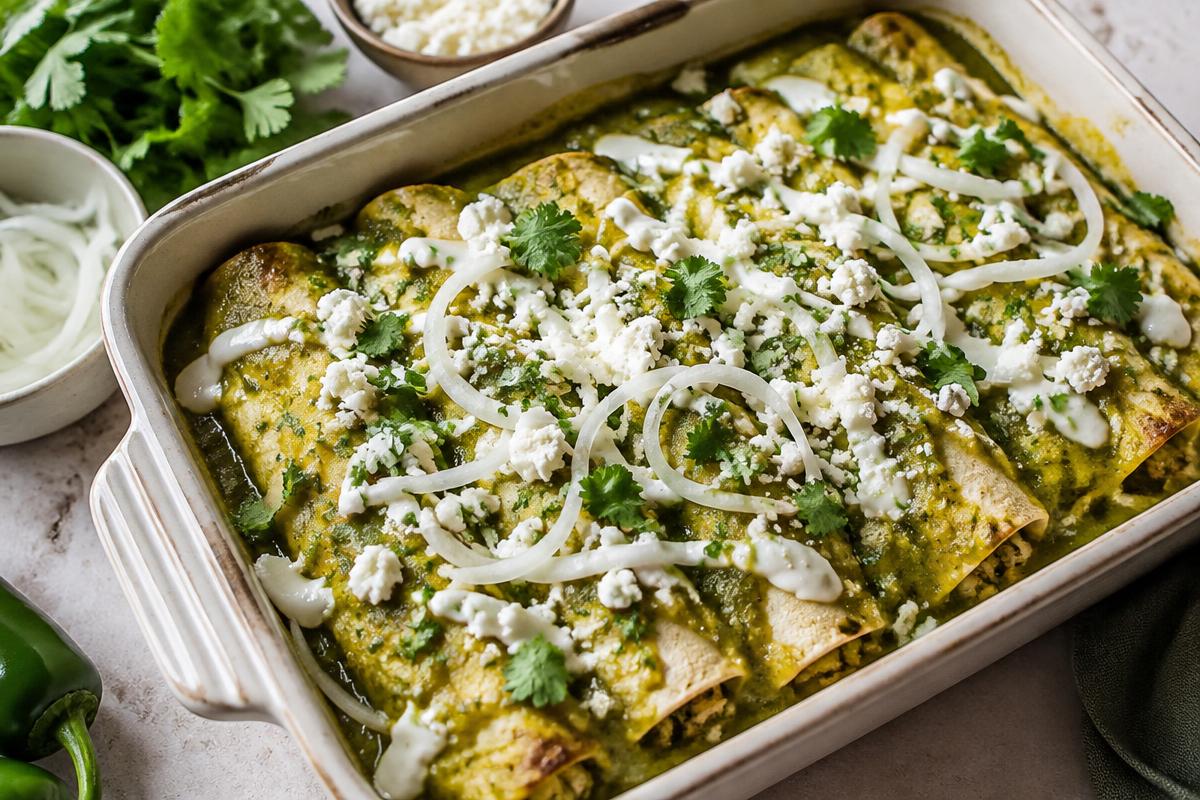
In traditional Mexican culinary culture, enchiladas are fundamentally a sauce-first dish. The tortilla is not baked under a suffocating two-inch layer of melted yellow cheddar cheese until gummy, as is common in Western adaptations. Instead, the fresh corn tortilla is lightly softened in hot lard (pasada por grasa), submerged completely into a bubbling, freshly simmered salsa verde, stuffed with lightly seasoned, tender shredded chicken or fresh cheese, rolled loosely, and garnished with crisp white onion, Mexican crema, and crumbly queso fresco.
Culinary Physics & Food Science: Tomatillos and Tortilla Integrity
1. The Chemistry of the Tomatillo: Pectin, Acidity, and Saponins
The tomatillo belongs to the nightshade family (Solanaceae), but its chemical profile is vastly different from that of a red tomato (Solanum lycopersicum).
- The Pectin Matrix: Raw tomatillos contain exceptionally high levels of natural pectin. When raw tomatillos are blended and simmered, these pectin long-chain polysaccharides hydrate and cross-link, giving authentic Mexican salsa verde its characteristic velvety, luscious body without requiring any added cornstarch or flour thickeners.
- Taming Malic and Citric Acidity: Raw tomatillos are aggressively acidic, dominated by malic and citric acids. If blended raw, salsa verde can taste sharp, sour, and astringent. By roasting the tomatillos on a cast-iron comal or under a high-heat broiler until charred and blistered:
- The heat breaks down complex starches into simple reducing sugars.
- The charred skin introduces smoky pyrazine compounds that neutralize harsh sour notes.
- The pectin bonds soften, allowing the pulp to emulsify smoothly with chiles, garlic, and fresh cilantro.
- The Saponin Rinsing Step: Tomatillos are wrapped in a papery husk (calyx). Beneath this husk is a sticky, resinous film composed of withanolides and saponins produced by the plant to deter insects. If not washed off with warm water, this film imparts a bitter, soapy aftertaste to the salsa.
2. The Tortilla Tempering Secret (Pasar por Grasa)
The most common disaster for home cooks making enchiladas is the dreaded "soggy mush syndrome": tortillas that tear, disintegrate, and dissolve into paste when rolled or baked.
- Why Corn Tortillas Break: A cold corn tortilla is brittle because its gelatinized corn starches have retrograded. If you attempt to roll it cold, it cracks. If you dip it directly into hot, watery salsa without oil, the tortilla acts as a sponge, absorbing water instantly until the structural amylose matrix collapses.
- The Oil/Lard Barrier: Authentic Mexican cooks briefly submerge each tortilla in hot pork lard or neutral oil (heated to 350°F / 175°C) for just 5 to 8 seconds per side. This achieves three crucial structural transformations:
- The rapid heat instantly resets the starch polymers, making the tortilla completely supple, pliable, and crack-resistant.
- The hot fat seals the surface pores of the tortilla, creating a hydrophobic microscopic lipid barrier that prevents the sauce from waterlogging the corn dough.
- It imparts deep richness and authentic flavor that water-steaming in a microwave cannot replicate.
Ingredient Anatomy & Sourcing
1. The Tomatillos
Seek out small to medium tomatillos that fill their papery husks tightly. Smaller tomatillos have higher sugar-to-acid ratios and fewer watery seeds than large, overgrown varieties. Look for husks that are pale tan and slightly dry, with firm, bright green fruit underneath.
2. The Chiles: Serrano vs. Jalapeño
Authentic central Mexican salsa verde relies on fresh serrano chiles. Serranos offer a brighter, more herbal, razor-sharp heat that cuts through rich chicken and crema far better than sweet, grassy jalapeños.
3. The Dairy: Queso Fresco & Mexican Crema
- Queso Fresco: A fresh, salted curd cheese made from cow's milk. It does not melt into a greasy pool; rather, it softens slightly under heat while maintaining a clean, salty, milky crumble. (Substitute with salted French feta rinsed in cold water, or mild farmer's cheese).
- Crema Mexicana: Unlike American sour cream, which is cultured with high lactic acidity (pH ~4.5) and heavy stabilizers, authentic Mexican crema is thinner, sweeter, richer (around 30% butterfat), and lightly soured. (Substitute by whisking 1 cup heavy cream with 2 tablespoons buttermilk and letting it sit on the counter for 12 hours until thickened).
4. The Poultry
Do not use dry, roasted chicken breast. Simmer bone-in, skin-on chicken breasts and thighs with onion, garlic, and cilantro stems in water. Shred the warm meat by hand into long, juicy strands, seasoning it with a splash of the poaching broth and fine sea salt.
Complete Ingredient Roster
- The Poached Chicken Filling:
- 1.5 lbs (700 g) bone-in, skin-on chicken breasts or thighs
- 1/2 medium white onion
- 4 cloves garlic, smashed
- 1 bay leaf
- 1 teaspoon coarse sea salt
- 4 cups water (reserve the resulting broth for the salsa)
- The Roasted Salsa Verde:
- 1.5 lbs (700 g) fresh tomatillos, husks removed and fruit washed thoroughly in warm water
- 3–4 fresh serrano chiles, stems removed (adjust based on heat tolerance)
- 1/2 large white onion, roughly chopped
- 4 cloves garlic, peeled
- 1 cup tightly packed fresh cilantro leaves and tender stems
- 1 cup reserved hot chicken poaching broth
- 1 tablespoon pure rendered pork lard (manteca) or avocado oil
- 1.5 teaspoons fine sea salt (or to taste)
- 1/4 teaspoon ground cumin (optional, subtle whisper)
- The Tortillas & Assembly:
- 12 fresh 6-inch stone-ground corn tortillas (preferably yellow or white nixtamalized corn)
- 1/2 cup pure pork lard or neutral frying oil (for tempering tortillas)
- The Traditional Garnishes:
- 1 cup Queso Fresco, crumbled
- 1/2 cup Crema Mexicana (or crème fraîche)
- 1/2 small white onion, sliced into paper-thin rings or finely diced
- 1/4 cup fresh cilantro leaves, roughly chopped
- 1 ripe Haas avocado, thinly sliced
Step-by-Step Master Method
Phase 1: Poaching the Chicken & Creating the Gold Broth
- In a medium saucepan, combine the bone-in chicken pieces, 1/2 white onion, smashed garlic cloves, bay leaf, coarse salt, and water.
- Bring to a boil over medium-high heat. Immediately reduce heat to low, cover with a tight-fitting lid, and simmer gently for 25 minutes until the internal temperature of the chicken registers 165°F (74°C).
- Remove chicken to a cutting board and let rest until cool enough to handle. Strain the fragrant poaching broth through a fine-mesh sieve and reserve 1 cup for the salsa.
- Discard chicken skin and bones. Using your fingers or two forks, shred the warm meat along the grain into bite-sized shreds. Toss with 3 tablespoons of warm poaching broth and a pinch of salt to keep the meat exceptionally juicy.
Phase 2: Blistering the Aromatics & Blending the Salsa
- Position an oven rack directly beneath your broiler and preheat to HIGH (or heat a dry cast-iron comal/skillet over high heat).
- Place the rinsed tomatillos, whole serrano chiles, roughly chopped 1/2 onion, and peeled garlic cloves on a heavy rimmed baking sheet.
- Broil for 6 to 8 minutes, watching carefully. The tomatillo skins should blister, blacken in spots, and turn from bright emerald to a pale olive green. Flip once halfway through. Remove before the tomatillos burst completely and lose their internal juices onto the tray.
- Transfer the blistered tomatillos, chiles, onion, and garlic (along with any charred pan juices) into a high-speed blender.
- Add the fresh cilantro, 1 cup reserved chicken broth, fine sea salt, and cumin.
- Blend on high speed for 60 to 90 seconds until the sauce is completely liquefied, emulsified, and velvety smooth.
Phase 3: Frying the Salsa (Guisar la Salsa)
- In a wide, deep skillet or Dutch oven, melt 1 tablespoon of lard or oil over medium heat.
- Pour the blended green salsa into the hot fat all at once. It will sizzle aggressively.
- Bring to a steady simmer, reduce heat to medium-low, and cook uncovered for 8 to 10 minutes, stirring occasionally. Sensory Cue: The salsa will deepen in color, and the natural tomatillo pectins will activate, transforming the sauce into a rich, glossy gravy that lightly coats the back of a wooden spoon. Taste and adjust salt if needed. Keep warm over very low heat.
Phase 4: Tempering the Corn Tortillas (Pasar por Grasa)
- In a small skillet, heat 1/2 cup of lard or oil over medium-high heat until shimmering (around 350°F / 175°C).
- Place a paper-towel-lined plate next to the skillet.
- Using metal tongs, slide one fresh corn tortilla into the hot fat. Fry for exactly 5 to 6 seconds, flip, and fry for another 5 seconds. The tortilla must become limp, pliable, and glistening, NOT crispy or toasted like a tostada.
- Lift the tortilla, let excess oil drip back into the pan for two seconds, and transfer to the paper towels. Repeat with all 12 tortillas.
Phase 5: Assembly and Baking
- Preheat oven to 375°F (190°C). Lightly grease a 9x13-inch ceramic baking dish.
- Spoon 1/2 cup of warm salsa verde into the bottom of the dish to create a non-stick bed.
- The Dipping Protocol: Take one tempered tortilla and submerge it completely into the pot of warm salsa verde for 3 seconds using tongs.
- Lay the sauced tortilla flat on your work surface. Place 2 to 3 tablespoons of shredded chicken down the center.
- Roll the tortilla snugly around the chicken (do not fold the ends). Place seam-side down in the baking dish.
- Repeat with the remaining tortillas, packing them snugly side-by-side.
- Pour the remaining warm salsa verde evenly over the top of the rolled enchiladas, ensuring every exposed tortilla surface is coated.
- Scatter half of the crumbled queso fresco across the top.
- Bake uncovered at 375°F for 12 to 15 minutes—just until the sauce bubbles at the perimeter and the cheese warms through. (Do not bake for 30–40 minutes; over-baking breaks down the tortillas).
Phase 6: Garnishing & Service
- Remove from oven. Immediately drizzle with Crema Mexicana in a zigzag pattern across the enchiladas.
- Top with the remaining crumbled queso fresco, paper-thin white onion rings, chopped fresh cilantro, and sliced avocado. Serve immediately while piping hot with Mexican red rice (arroz rojo) and refried pinto beans.
Crucial Kitchen Errors & Troubleshooting Matrix
| Problem | Root Food Science Cause | Immediate Kitchen Remedy | Future Batch Prevention |
|---|---|---|---|
| Tortillas torn and dissolved into soggy mush | Tortillas were not tempered in hot oil, or enchiladas were baked too long (>25 mins). | Scoop into shallow bowls and serve as a rustic Chilaquiles Verdes casserole. | Flash-fry tortillas in 350°F lard for 5 seconds per side to seal starches; limit bake to 15 mins. |
| Salsa verde is painfully sour and acidic | Overly large, under-ripe tomatillos used; insufficient roasting or lack of salt. | Stir in 1/4 teaspoon baking soda (neutralizes acid via effervescence) or 1/2 teaspoon white sugar. | Roast tomatillos until charred to break down malic acids; use small, ripe tomatillos. |
| Salsa is thin and watery in the baking dish | Tomatillos were boiled in water instead of roasted, or salsa was not fried in lard (guisada). | Broil on HIGH for 3 minutes to rapidly evaporate surface moisture. | Simmer the pureed salsa in hot lard for 10 minutes to activate natural pectins before assembly. |
| Tortillas cracked during rolling | Cold, dry tortillas rolled without fat immersion, fracturing retrograded starch bonds. | Warm cracked tortillas in the microwave between damp paper towels for 15 seconds, then roll. | Always submerge each tortilla in hot oil until completely supple before filling. |