Cultural Provenance: The Albufera Lagoon and the Valencian Hearth
Paella is Spain's most iconic culinary export, yet few dishes outside Italy have suffered more rampant distortion. In tourist taverns across the globe, paella is often misrepresented as a wet, yellow rice risotto piled indiscriminately with chorizo, peas, chicken, and rubbery squid rings. To a Spaniard—particularly in the coastal villages surrounding the Albufera freshwater lagoon in Valencia where paella was born—this is considered culinary heresy (arroz con cosas—"rice with things").
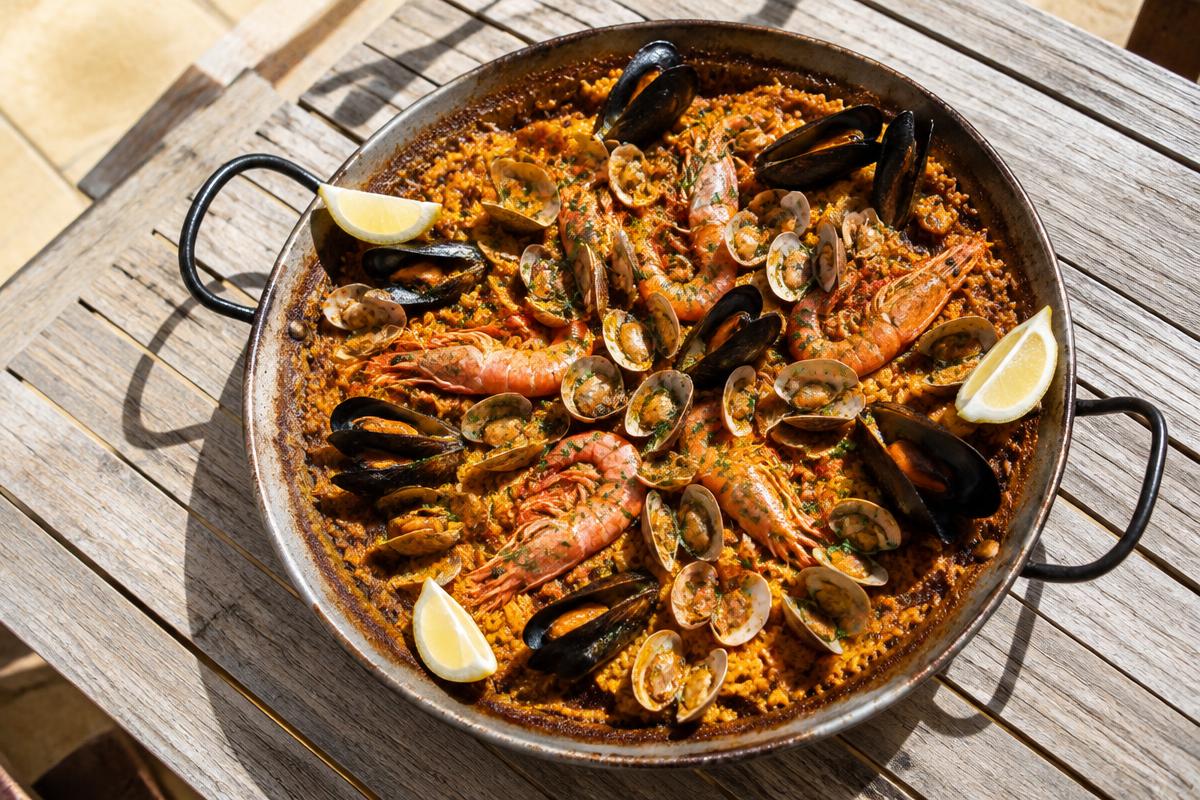
The word paella derives from the Old French paelle, rooted in the Latin patella, designating a flat, shallow, two-handled pan. Historically, 18th-century farm workers in Valencia cooked rice over outdoor orange-wood bonfires, using what the marshland provided: water voles, rabbit, snails (vaquetes), and flat green beans (ferraura). As the culinary tradition traveled south along the Mediterranean coast to Alicante and north to the Costa Brava, the maritime iteration—Paella de Marisco (Seafood Paella)—was perfected by fishermen using rockfish broths (morralla), fresh prawns, and cuttlefish.
Authentic Spanish paella is fundamentally a study in rice cookery. The proteins and seafood are merely seasoning agents designed to sacrifice their juices into a rich stock. That stock is subsequently absorbed by a broad, paper-thin sheet of specialized short-grain rice that must cook undisturbed until a caramelized, crackling, toasted base layer forms against the bottom of the steel pan: the legendary Socarrat.
The Molecular Science of Bomba Rice & Socarrat Formation
1. Why Italian Arborio and Asian Jasmine Fail in Paella
You cannot make authentic Spanish paella with sushi rice, basmati, or Italian risotto rice.
- Arborio / Carnaroli (Risotto Rice): High in surface amylopectin. When stirred, risotto rice sheds starch into the cooking liquid, creating a thick, creamy, unctuous emulsion. Paella must never be creamy; the grains must remain distinct, dry, and separated.
- Bomba Rice (Oryza sativa L. f. bomba): Grown in the microclimates of Calasparra and Valencia, Bomba is an ancient short-grain cultivar with an exceptionally high amylose content (~24%).
- The Sponge Phenomenon: Bomba rice can absorb three times its volume in rich seafood stock without bursting or disintegrating. While ordinary rice expands lengthwise, Bomba expands like an accordion like a small pearl, locking the collagen and marine flavors inside its internal cellular matrix while remaining toothsome (al dente).
2. The Chemistry of Socarrat (Maillard vs. Caramelization vs. Carbon)
The pinnacle of paella craftsmanship is the Socarrat (derived from the Valencian verb socarrar, "to singe or toast"). Socarrat is not burnt rice; burnt rice is black, bitter, carcinogenic, and acrid.
- True socarrat is a golden-amber to deep-mahogany crust formed by two distinct scientific events occurring in the final 3 minutes of cooking:
- Starch Dehydration & Oil Concentration: As the liquid broth is completely absorbed and vaporized by the rice, the rendered olive oil and seafood fats sink to the bottom of the steel paella pan.
- The High-Heat Fry: The bottom layer of rice grains begins to fry in this concentrated lipid bath. The reducing sugars from the caramelized sofrito and the amino acids from the seafood broth undergo an intense Maillard reaction, welding the bottom layer into a continuous, savory, crackling mosaic that emits a distinct sizzle and a nutty popcorn aroma.
3. The Pan Architecture: Surface Area to Depth Ratio
A traditional paellera is shallow, wide, and stamped from thin carbon steel with dimples.
- The dimples are engineered to distribute heat evenly and capture pockets of starch.
- The Depth Rule: In Spain, the rice layer must never exceed one finger’s depth (less than 1/2 inch / 1.5 cm). If rice is piled deep like pilaf, steam gets trapped in the lower layers, resulting in unevenly cooked, soggy rice and preventing the bottom grains from frying into socarrat.
Ingredient Anatomy & Sourcing
1. The Flavor Engine: Salmorreta / Sofrito
In Alicante and Valencia, seafood paella relies on a concentrated paste called Salmorreta:
- Dried sweet Ñora peppers (rehydrated and scraped for pulp)
- Ripe grated tomatoes (skins discarded)
- Fresh garlic and flat-leaf parsley
- Slowly caramelized in Spanish extra virgin olive oil until it reduces into a jammy, dark mahogany paste.
2. Saffron (Azafrán): The King of Spices
Never use synthetic yellow food coloring powder (colorante alimentario / tartrazine). Authentic paella demands genuine Spanish saffron threads (Crocus sativus). Saffron provides crocin (luminous golden color), picrocrocin (subtle, aristocratic bitter warmth), and safranal (floral, honeyed aroma). Saffron threads must be gently toasted, crushed into powder, and steeped in warm stock to extract these volatile pigments.
3. The Seafood Stock (Caldo de Marisco / Fumet)
Paella can only be as good as the stock that hydrates the rice. Do not use plain water or canned chicken bouillon. Simmer shrimp/prawn heads and shells, rockfish carcasses, onion, leek, and a pinch of fennel in water for 30 minutes. Squeeze the heads of the prawns directly into the stock to release their rich hepatopancreas juices (the source of intense umami).
Complete Ingredient Roster
- The Rice:
- 2 cups (400 g) authentic Spanish Bomba rice (or Calasparra rice; do not substitute with Arborio or long-grain rice)
- The Rich Seafood Stock (Fumet):
- 6 cups rich homemade seafood stock (kept at a bare simmer)
- 1 generous pinch (approx. 30–40 threads) premium Spanish saffron
- The Seafood Roster:
- 12 large wild jumbo shrimp or Spanish red prawns (carabineros), head-on and shell-on
- 8 oz (225 g) fresh squid or cuttlefish (sepia), cleaned and sliced into 1/2-inch rings and tentacles
- 12 fresh Mediterranean mussels or clams, scrubbed and debearded
- The Salmorreta / Sofrito Base:
- 1/3 cup cold-pressed Spanish Extra Virgin Olive Oil
- 2 dried Ñora peppers (steeped in hot water, seeds removed, pulp scraped) or 1 tablespoon sweet Spanish smoked paprika (Pimentón de la Vera dulce)
- 1 medium yellow onion, grated or minced ultra-fine
- 4 cloves garlic, finely grated
- 2 large ripe tomatoes, halved and grated on a box grater (skins discarded)
- The Garnish:
- 1 fresh lemon, cut into wedges
- 2 tablespoons fresh flat-leaf parsley, finely chopped
Step-by-Step Master Method
Phase 1: Toasting the Saffron & Preparing the Fumet
- Place the saffron threads on a small piece of foil and hold it a few inches over a low burner for 15 seconds to gently dry the threads (do not scorch).
- Transfer threads to a small mortar, add a tiny pinch of salt, and grind to a fine scarlet powder.
- Pour 1/2 cup of warm seafood stock into the mortar, stir to dissolve, and pour back into the simmering stock pot. The broth should turn a luminous orange-gold. Keep stock at a gentle simmer on an adjacent burner.
Phase 2: Searing the Seafood (The Foundation)
- Place a 15- to 17-inch carbon steel paella pan over medium-high heat. Add the 1/3 cup of extra virgin olive oil. Level the pan using a bubble level or by observing oil distribution—level pan geometry is vital for uniform rice cooking.
- Season the head-on jumbo shrimp with coarse sea salt. Sear in the hot oil for 90 seconds per side until pink and fragrant. Remove to a plate. (They will finish cooking later on top of the rice).
- Add the sliced squid rings and tentacles to the hot oil. Sauté for 2 minutes until opaque and lightly golden. Push to the outer edges of the pan.
Phase 3: Building the Sofrito (The Flavor Core)
- Drop the heat to medium-low. Add the grated onion, grated garlic, and scraped ñora pepper pulp (or smoked pimentón) into the center of the pan.
- Cook slowly, stirring constantly with a wooden spoon for 5 to 7 minutes until the onion is sweet and translucent.
- Pour in the grated tomato pulp. Cook for 8 to 10 minutes, stirring occasionally, until the water from the tomatoes completely evaporates. Sensory Cue: The sofrito will darken to a deep mahogany-burgundy paste, and the olive oil will begin to separate from the tomato solids (sofrito confitado).
Phase 4: Distributing the Rice & Adding the Stock
- Add the 2 cups of dry, unwashed Bomba rice into the pan with the sofrito.
- Cook, stirring continuously for 2 minutes, toasting each grain of rice in the flavorful sofrito oil (nacarar el arroz). Every grain should look glossy and translucent.
- Pour in 5 cups of the simmering golden saffron seafood stock (reserve 1 cup in case needed).
- Using your wooden spoon, distribute the rice evenly across the entire surface of the pan.
- The Cardinal Rule of Paella: AFTER THIS MOMENT, YOU MUST NEVER STIR THE RICE AGAIN. Stirring releases amylose starch into the liquid, turning your paella into a gummy, sticky risotto and destroying any chance of forming a socarrat.
Phase 5: The Two-Stage Simmer
- The High Boil (First 8 Minutes): Maintain vigorous medium-high heat. The stock should boil actively across the entire surface of the pan, allowing the grains of Bomba rice to hydrate evenly.
- The Low Simmer (Next 10 Minutes): Drop the heat to low. The boiling will subside into a gentle, rhythmic simmer. As the liquid level drops, the swollen rice grains will emerge above the surface like a golden mosaic.
- Arrange the seared shrimp and scrubbed mussels/clams across the top of the rice, pressing the shellfish hinge-side down into the rice so they steam open.
Phase 6: The Socarrat Creation (The Final 3–4 Minutes)
- Once all visible liquid has disappeared from the surface of the pan, listen closely to the pan.
- Acoustic Cue: The sound will change from a bubbling, hissing wet simmer to a steady, rhythmic crackling, popping sizzle (crepitar).
- Increase the heat to medium-high for 2 to 3 minutes. Rotate the paella pan over the burner every 45 seconds to ensure the heat reaches every quadrant of the base.
- Olfactory Cue: Lean over the pan. You will smell the rich aroma of toasted rice and caramelized seafood oils—similar to roasted nuts or toasted popcorn. If you smell harsh, acrid smoke, immediately kill the flame!
- The Needle Test: Insert the tip of a paring knife or spoon handle straight down through the rice to the bottom of the pan. It should meet a firm, crispy, sandpaper-like resistance, not soft mush. Turn off the heat.
Phase 7: The Holy Rest (El Reposo)
- Cover the paella pan loosely with a clean kitchen towel or sheets of newspaper.
- Let rest undisturbed for 5 to 8 minutes. This rest is non-negotiable: it allows the intense heat at the base of the pan to soften the socarrat slightly so it releases cleanly from the steel, while the trapped steam finishes cooking the upper layer of rice to absolute perfection.
- Garnish with fresh lemon wedges and chopped parsley. Serve directly from the pan in the center of the table with wooden spoons.
Crucial Kitchen Errors & Troubleshooting Matrix
| Problem | Root Food Science Cause | Immediate Kitchen Remedy | Future Batch Prevention |
|---|---|---|---|
| Rice is gummy, wet, and clumpy | Rice was stirred after liquid was added, or wrong rice variety used (Arborio/sushi). | None; serve as an Arroz Caldoso (brothy rice). | Use authentic Spanish Bomba rice; never stir after initial broth distribution. |
| Top rice grains are chalky and undercooked, but bottom is dry | Pan was too deep, burner was too small, or liquid evaporated too quickly. | Drizzle 1/2 cup warm stock over undercooked areas, cover tightly with foil for 5 mins on low heat. | Ensure pan diameter matches burner; use wide, shallow paellera so rice is less than 1/2 inch deep. |
| Socarrat is charred black and bitter | Pan left over high heat too long, or heat was concentrated in one central hot spot. | Scrape away bitter black burnt center; eat only the golden perimeter rice. | Rotate pan constantly in final 3 minutes; listen for the crackle and stop the moment it smells nutty. |
| Seafood is rubbery and tough | Shrimp and squid simmered in the liquid for the entire 20-minute cook time. | None for current batch; remove shrimp shells before eating. | Flash-sear seafood at the start, remove, and return to rest on top of rice only in the final 8 minutes. |