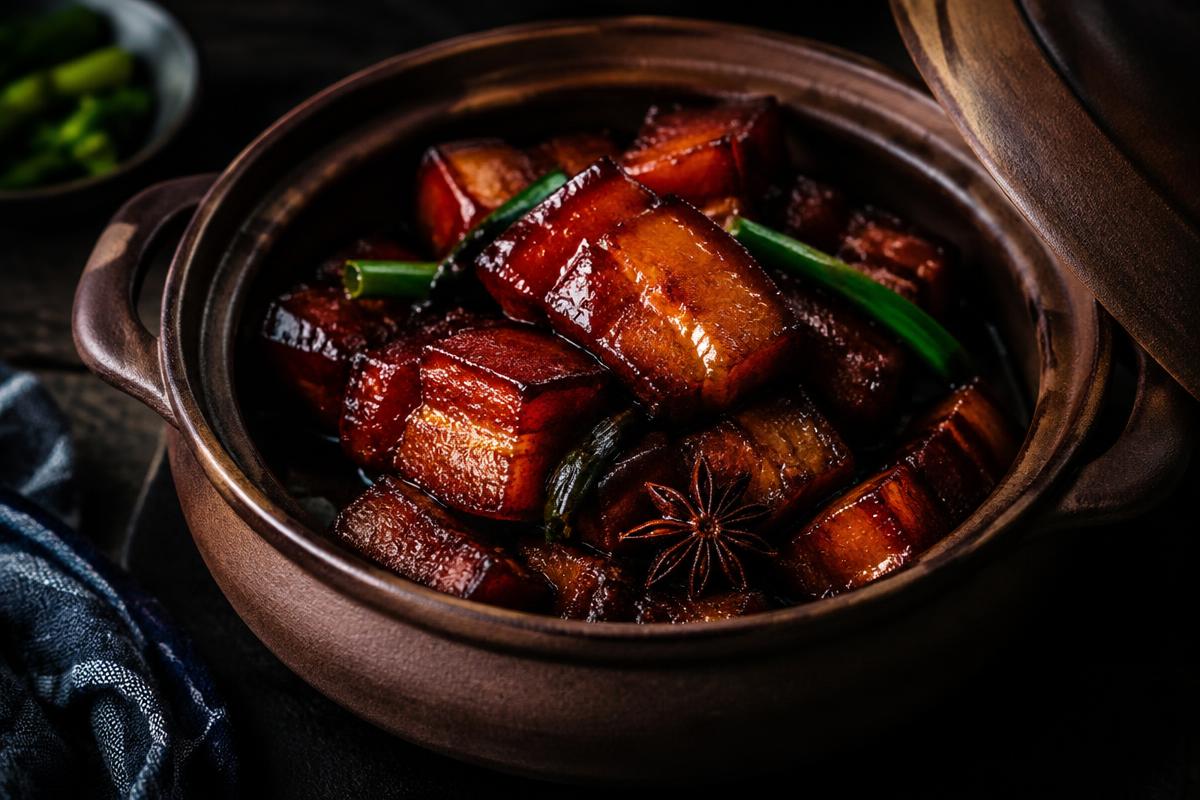
Hailing from the Jiangnan water towns along the Yangtze River and immortalized by poet Su Shi (as Dongpo Pork) and Chairman Mao Zedong in Hunan, Hong Shao Rou is a tour de force of slow braising. When executed correctly, each cube of pork belly quivers with gelatinous tenderness, encased in an amber glaze with an equilibrium of sweet, savory, and aromatic notes.
The Food Science of Red Braising
1. The Chemistry of Chao Tang (Sugar Caramelization)
Unlike Western stews that rely on flour or heavy roux for body, Hong Shao Rou derives its signature glossy lacquer from sugar thermal degradation (Chao Tang).
- Rock sugar (Bing Tang)—crystallized sucrose—is heated in oil over low heat. Between 320°F and 350°F (160°C–177°C), sucrose decomposes into glucose and fructose, which then dehydrate and polymerize into caramelan and caramelin compounds.
- Searing the parboiled pork in this foaming amber caramel coats the meat fibers in a micro-thin layer of glossy sugar, sealing in moisture and establishing the mahogany foundation before soy sauce is introduced.
2. The Two-Step Fat Transformation
Pork belly contains alternating strata of lean muscle and subcutaneous fat. Rapid boiling leaves the fat greasy and rubbery.
- Phase 1: Cold Water Blanching: Heating pork from cold water slowly expels denatured myoglobin, cellular debris, and surface impurities without shocking the exterior muscle.
- Phase 2: Hydrolytic Rendering: During a 90-minute sub-simmer (approx. 195°F / 90°C), the collagen within the connective tissue dissolves into gelatin, while the crystalline fats melt into silky, spoon-tender layers that melt on the tongue.
Comprehensive Ingredient Roster
- 2 lbs (900g) skin-on, five-layer pork belly (Wu Hua Rou), cut into uniform 1.25-inch (3cm) cubes
- 2 tbsp neutral peanut or canola oil
- 2.5 tbsp (35g) yellow Chinese rock sugar (Bing Tang), crushed (or granulated cane sugar)
- 1/3 cup (80ml) premium Shaoxing rice wine
- 2 tbsp (30ml) light soy sauce
- 1 tbsp (15ml) dark soy sauce (for deep mahogany lacquer)
- 2.5 cups (600ml) boiling water or light unsalted chicken stock
- 6 slices fresh ginger (1/4-inch thick), lightly smashed
- 3 whole scallions (green onions), tied into a tight knot
- 2 whole star anise pods
- 1 small stick (2 inches) Chinese cassia bark or cinnamon
- 1 black cardamom pod (Cao Guo), lightly cracked (optional, for earthy warmth)
- 4 hard-boiled eggs, peeled and lightly scored with 4 shallow lengthwise slits (optional)
- Blanched baby bok choy, for serving
Step-by-Step Execution Protocol
- The Cold Water Blanch: Place the cubed pork belly into a large pot. Cover with cold tap water by at least 2 inches. Add 2 slices of ginger, 1 smashed scallion, and 1 tablespoon of Shaoxing wine. Bring to a boil over medium-high heat. Let boil vigorously for 3–4 minutes as grey scum rises to the surface. Drain pork through a colander, rinse thoroughly with warm water, and pat completely dry with paper towels. (Dry pork prevents hot oil splatter during caramelization).
- Execute Chao Tang (The Caramel Coating): In a wok or heavy Dutch oven, heat 2 tablespoons of oil and the crushed rock sugar over low heat. Stir continuously with a wooden spoon or spatula. As the sugar dissolves, it will foam into small, golden bubbles. Watch vigilantly: when the color shifts from golden to a rich reddish amber with a fragrant, toasty aroma (about 4–5 minutes), immediately add the dried pork cubes.
- Sear in the Caramel: Increase heat to medium. Stir-fry the pork vigorously for 3 minutes. Every facet of the pork cubes should take on a glossy, translucent amber lacquer. Fat will begin to render into the pan.
- Deglaze with Aromatics: Add the remaining ginger slices, scallion knot, star anise, cassia bark, and cracked black cardamom. Stir-fry for 1 minute until spices are fragrant. Pour the Shaoxing wine around the perimeter of the wok, letting it hiss and reduce for 30 seconds.
- The Long Braise: Pour in the light soy sauce, dark soy sauce, and 2.5 cups of boiling water (the liquid should reach about 80% up the sides of the pork cubes—never use cold water, which tightens the hot meat fibers). Bring to a rolling boil, then reduce heat to the lowest setting. Cover with a tight-fitting lid and simmer undisturbed for 75 minutes. If using hard-boiled eggs, add them after 45 minutes of simmering, submerging them into the braising liquid.
- The Master Reduction (Shou Zhi): Remove the lid. Discard the spent scallion knot, star anise, and cinnamon stick. The pork should be extraordinarily tender, and the liquid will still be relatively thin. Turn the heat up to medium-high. Gently stir the pork constantly to prevent sticking. As the water evaporates, the gelatin, rendered fat, and caramelized sugars will emulsify into a thick, glossy syrup that coats each piece of pork like chocolate glaze (about 8–10 minutes).
- Plating: Arrange blanched baby bok choy around the edge of a wide, warm platter. Pile the mahogany-glazed pork cubes in the center. Halve the braised eggs and place alongside. Serve immediately with warm Jasmine rice.
Troubleshooting Matrix
- Problem: The sugar burned and smells bitter during Chao Tang.
Fix: There is no culinary remedy for burnt sugar. Discard the contents of the pan, wipe it clean, and start the sugar-oil caramel step over. Keep heat strictly low. - Problem: The pork is tender, but the skin is tough or chewy.
Fix: The braising temperature was too low, or the liquid evaporated prematurely. Add 1/2 cup boiling water, cover, and braise for an additional 20 minutes before performing the final reduction.