Cultural Provenance: The Litmus Test of the Chinese Master Chef
In the culinary hierarchy of Cantonese and Chinese kitchens, nothing reveals a chef’s true mastery of fire and metal quite like a simple bowl of Dan Chao Fan (蛋炒饭—Egg Fried Rice).
Originating during the Sui Dynasty (581–618 AD) in the city of Yangzhou, Jiangsu province, fried rice was born from the timeless Chinese ethos of thrift and reverence for grain: never waste leftover cooked rice. Over centuries, what began as an ingenious method to rejuvenate day-old starch evolved into the ultimate technical demonstration of wok cookery.
When an apprentice chef auditions for a master Cantonese brigade, they are not asked to cook complex bird's nest or abalone. They are handed a carbon steel wok, two eggs, a bowl of cold rice, and a pair of long chopsticks. The master chef listens to the rhythm of the spatula, observes the motion of the wrist, and inspects the finished dish. A true egg fried rice must achieve the legendary condition of Sui Mi Fen Li (碎米分离—each grain separated, individual, and shimmering), completely coated in egg with zero clumping, zero grease pooling at the bottom of the bowl, and imbued with the unmistakable breath of the wok: Wok Hei.
The Molecular Physics of Wok Cookery: The Science of Wok Hei
1. What is Wok Hei (锅气)?
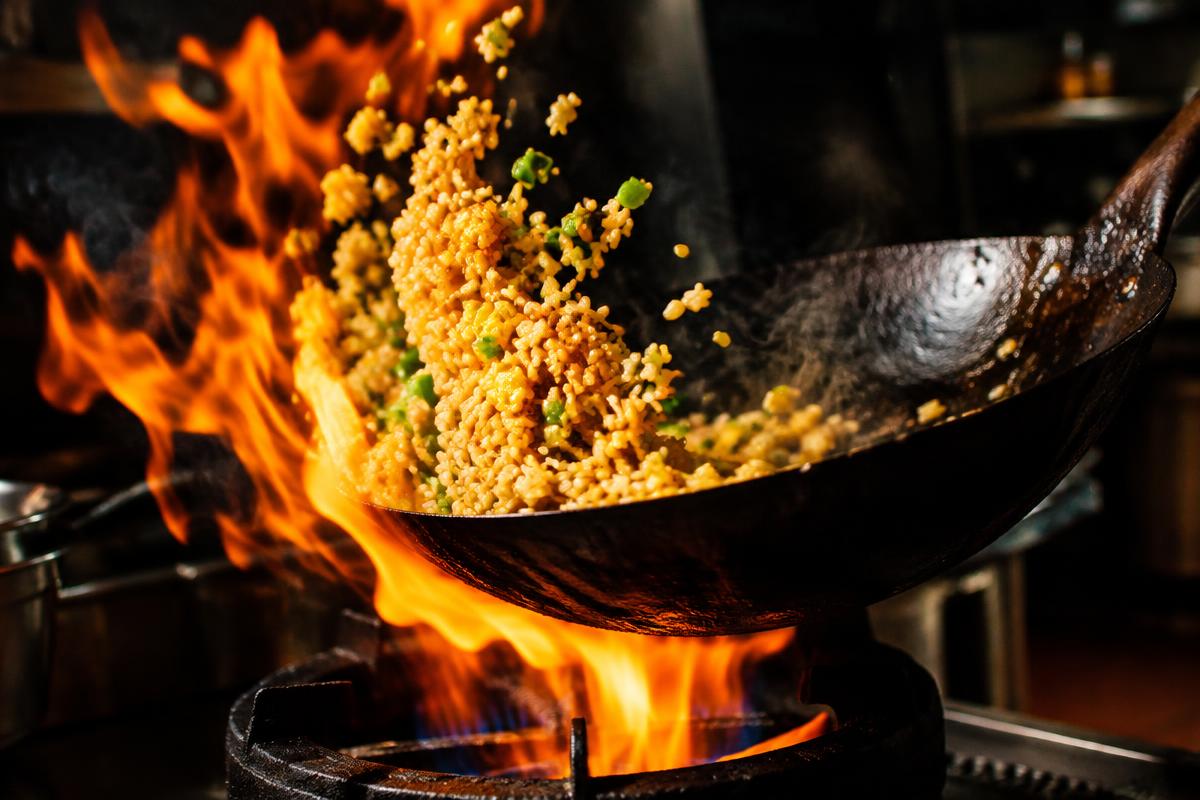
Western food writing often mistranslates Wok Hei as merely "smoky flavor." In the realm of organic chemistry and thermodynamics, Wok Hei ("breath of the wok") is a complex sensory phenomenon produced by three interlocking reactions occurring simultaneously at extreme temperatures (>400°F–500°F / 200°C–260°C):
- Pyrolysis of Atomized Oil Droplets: As the chef rhythmically tosses the rice in a curved carbon steel wok, microscopic droplets of cooking oil become airborne in the turbulent convective plume above the wok rim. When these atomized oil particles pass through the roaring flame column (which can exceed 1,200°F / 650°C), they undergo instantaneous thermal pyrolysis—cracking into volatile aromatic polymers that rain back onto the dancing grains of rice.
- The Ultra-Fast Maillard Cascade: Because carbon steel transfers thermal energy rapidly, individual rice grains undergo rapid surface caramelization in milliseconds without losing their internal moisture.
- Steam Flash Evaporation: The intense heat instantly flashes off surface water, keeping the exterior of the grain dry and toothsome while locking moisture deep in the grain core.
2. The Starch Retrogradation Imperative (Why Fresh Rice Fails)
Freshly steamed rice is disastrous for fried rice. Fresh rice grains are swollen with water, and their surface starch molecules (amylose and amylopectin) form a sticky, amorphous gel. When thrown into a hot wok, these surface starches fuse into an inseparable, gummy mass.
- The Retrogradation Process: When cooked rice is spread onto a baking sheet and cooled in the refrigerator for 12 to 24 hours, the amylose polymers realign into crystalline, rigid structures—a chemical process known as starch retrogradation.
- The surface of each grain becomes firm, dry, and resilient, allowing it to withstand the aggressive mechanical friction of the wok spatula and toss without breaking or turning into porridge.
3. The Golden Rice vs. Silver-Covered-Gold Method
In Chinese classical cookery, there are two primary methods for incorporating eggs:
- Yin Bao Jin (Silver Covered in Gold / Traditional Method): The eggs are beaten and poured into hot oil in the wok, scrambled into soft, fragrant micro-curds, pushed aside, and the rice is added.
- Jin Guo Yin (Gold Wrapped in Silver / The Golden Rice Method): Raw egg yolks are mixed directly into the cold rice grains before cooking, coating every individual starch crystal in lipids and protein. When the rice hits the wok, the egg cooks instantly around each grain, guaranteeing 100% grain separation and a luminous yellow hue.
- Our master recipe employs the traditional restaurant method with an advanced hybrid technique to achieve both tender curds and individual grain separation.
Deep Ingredient Anatomy & Sourcing
1. The Rice Variety: Jasmine Rice vs. Short Grain
Never use short-grain sushi rice or glutinous sweet rice; their high amylopectin content makes them naturally sticky. The ideal grain is aged long-grain Jasmine rice from Thailand. Aged rice has lost excess internal moisture during post-harvest storage, producing a firm, dry, aromatic grain that separates flawlessly.
2. The Fat: Rendered Lard (Zhu You) vs. Neutral Oil
In traditional high-end Cantonese banquet kitchens, fried rice is executed with freshly rendered pork lard (Zhu You). Pork lard has a smoke point of 370°F (188°C) and contains oleic and palmitic fatty acids that coat starch granules with profound savory richness. If unavailable, use peanut oil or refined avocado oil.
3. The Soy Sauce Protocol
Amateur cooks often drench fried rice in dark soy sauce, turning it into a soggy, brown, salty mess. Authentic egg fried rice should be pale golden-ivory.
- Use only a whisper of light soy sauce (Sheng Chou), splashed strictly against the scorching hot metal walls of the wok, never poured directly onto the rice. This flashes the soy sauce into aromatic vapor and caramelizes its sugars in a microsecond before it touches the grain.
Complete Ingredient Roster
- The Rice Base:
- 4 cups cooked long-grain Jasmine rice (measured after cooking), chilled uncovered in the refrigerator for 12–24 hours
- The Eggs:
- 4 large fresh eggs (preferably pasture-raised for vibrant orange yolks)
- 1/4 teaspoon fine sea salt
- 1/2 teaspoon toasted sesame oil
- The Aromatics & Fats:
- 3 tablespoons pure rendered pork lard (or peanut oil / neutral high-heat oil)
- 4 scallions (spring onions), separated into white and green parts:
- White parts: finely sliced into rounds (for wok-blooming)
- Green parts: sliced into 1/4-inch rounds (for the final garnish)
- 2 cloves garlic, finely minced (optional, homestyle preference)
- The Seasoning & Searing Liquid:
- 1 teaspoon fine sea salt (or to taste)
- 1/2 teaspoon white sugar (balances savory notes)
- 1/2 teaspoon premium ground white pepper (non-negotiable for authentic Chinese aroma)
- 1 teaspoon light soy sauce
- 1 teaspoon Shaoxing cooking wine (splashed along wok rim)
- 1/4 teaspoon MSG (monosodium glutamate, optional but essential for restaurant-grade umami)
Step-by-Step Master Method
Step 1: Rice Grain Separation Calibration
- Remove the chilled rice from the refrigerator 20 minutes before cooking.
- Wash your hands thoroughly and dry them. Pour 1 tablespoon of cooking oil over your palms.
- Gently rub the cold rice between your palms and fingers, breaking apart any dense clumps into individual, separated grains. If the grains are separated before they hit the wok, you will not have to violently crush them with your spatula under heat.
Step 2: The Egg Preparation
- Crack the 4 eggs into a small bowl.
- Add 1/4 teaspoon salt and 1/2 teaspoon toasted sesame oil.
- Whisk with chopsticks for 30 seconds until the yolks and whites are fully integrated into a uniform golden liquid with no visible albumen strings.
Step 3: Seasoning and Heating the Wok (Long You)
- Place a 14-inch seasoned carbon steel wok over your highest stovetop burner flame.
- Heat the dry wok until wisps of blue-white smoke emerge from the metal and a drop of water flicked onto the surface dances and vaporizes in under one second (approx. 450°F / 230°C).
- Swirl in 2 tablespoons of lard or peanut oil around the sloping walls of the wok to create an ultra-slick, non-stick patina (Long You). Pour off excess oil if pooled, leaving a glistening coating.
Step 4: Scrambling the Egg Clouds
- Pour the whisked eggs directly into the center of the smoking wok. The eggs will immediately puff, expand, and blister vigorously in the hot fat.
- Using the rounded edge of your wok spatula, stir the eggs in rapid circular motions for just 8 to 10 seconds. You want soft, silky, 70% cooked curds that are still slightly runny on top.
- Immediately scrape the soft egg curds out of the wok into a clean bowl. Do not let them overcook or brown at this stage.
Step 5: The High-Heat Rice Searing
- Add the remaining 1 tablespoon of lard or oil to the scorching wok.
- Toss in the sliced white parts of the scallions and minced garlic. Stir-fry for 10 seconds until intensely aromatic.
- Dump the separated, room-temperature rice into the wok all at once.
- The Spatula & Toss Motion: Spread the rice across the curved surface of the wok in a flat, even layer using the back of your spatula. Let the grains sear undisturbed against the screaming-hot metal for 15 seconds to develop initial Maillard toasted notes.
- Begin tossing the wok rhythmically while pushing and folding the rice with your spatula. Continue tossing over maximum heat for 2 to 3 minutes.
- Acoustic Cue: You will hear the rice begin to crackle, pop, and dance across the metal surface like tiny popping seeds as the residual internal moisture turns to steam.
Step 6: Seasoning and Integrating
- Sprinkle the 1 teaspoon salt, 1/2 teaspoon sugar, 1/2 teaspoon white pepper, and optional MSG evenly across the dancing rice. Toss vigorously for 30 seconds to distribute.
- Return the reserved soft scrambled eggs to the wok. Using the sharp edge of the spatula, chop the soft curds into small, golden flecks while tossing continuously to integrate them evenly throughout the rice.
Step 7: The Rim Splash (Guo Bian Lin) & Scallion Finish
- Push the rice slightly toward the center of the wok.
- Splash the 1 teaspoon of light soy sauce and 1 teaspoon of Shaoxing wine directly against the top perimeter of the sloping hot metal walls of the wok, NOT directly onto the rice.
- The liquid will sizzle violently, caramelize in a split second, and cascade down into the rice as pure, smoky vapor.
- Toss the rice frantically for 20 seconds to coat every grain in this caramelized vapor.
- Turn off the heat. Dump in the sliced green scallion batons. Give 3 final vigorous tosses—the residual heat will wilt the green scallions, releasing their sweet, fresh allium oils. Slide immediately onto a wide serving platter.
Crucial Kitchen Errors & Troubleshooting Matrix
| Issue | Culinary Physics Failure Point | How to Salvage Current Dish | Future Batch Prevention |
|---|---|---|---|
| Rice is a wet, sticky, clumpy porridge | Freshly cooked warm rice used; high surface moisture gelatinized during stirring. | Spread rice onto a wide baking sheet and bake at 375°F for 8 mins to dry out surface starch. | Use 12–24 hour cold-refrigerated Jasmine rice; separate grains by hand before cooking. |
| Rice tastes bland and oil-greasy | Wok was not hot enough; fat was absorbed into the grains rather than searing the exterior. | Toss with extra freshly sliced green scallions and an extra dusting of white pepper. | Heat wok until smoking before adding oil; cook over the highest burner output available. |
| Burnt, bitter soy sauce flavor | Soy sauce poured directly onto cold rice or left to burn on the bottom of the wok. | Discard charred bits; balance with a light drizzle of toasted sesame oil. | Splash soy sauce strictly along the high upper rim of the wok so it vaporizes instantly. |
| Eggs are dry, rubbery, and gray | Eggs were overcooked during the initial scramble or left in the wok while rice seared. | None for current batch; chop finely and toss with extra green onions. | Cook eggs for only 8–10 seconds until soft curds form; remove immediately before adding rice. |