Cultural Provenance: The Copper Cauldrons of Quiroga and Uruapan
In the central-western state of Michoacán, Mexico—specifically in the pilgrimage towns of Quiroga and Uruapan—carnitas is not merely a recipe; it is a sacred culinary institution governed by the guild of maestros carniceros (master butchers).
The word carnitas translates literally as "little meats," but the dish has nothing in common with the quick-braised, water-boiled shredded pork often served in Western fast-casual restaurants. True carnitas traces its origins to the 16th century, born from the encounter between indigenous Mexican cooking techniques and the domesticated pigs, citrus, and spices introduced from the Old World.
In Quiroga, an authentic carnitas workshop prepares whole pigs in massive, hand-hammered copper cauldrons called cazos de cobre, crafted by artisans in nearby Santa Clara del Cobre. Copper is not chosen for aesthetic charm; its extraordinary thermal conductivity ensures that fierce wood fires transfer heat with absolute uniformity across the entire base and curved sides of the vessel. This prevents scorching while allowing several hundred pounds of pork cuts—shoulder (maciza), belly (pancita), ribs (costilla), skin (cueritos), and offal—to gently confit in pure, bubbling pork lard (manteca) over the course of four to five hours.
When you order carnitas in Michoacán, you do not simply order "pork"; you order by the cut. A plate of surtida (mixed cuts) provides the interplay between lean, gelatinous, and crisp textures that defines true carnitas artistry.
Culinary Physics & Food Science: Why Carnitas is Confit, Not a Braise
To understand why so many home recipes fail to achieve authentic carnitas texture, one must analyze the thermodynamics of water versus fat.
1. The Chemistry of Fat Confit vs. Water Braising
- The Boiling Water Trap: Water boils at 212°F (100°C) at sea level. When pork shoulder is boiled in chicken stock, water, or citrus juices, the high heat forces the actin and myosin muscle proteins to denature rapidly and squeeze out intracellular water like a wrung-out sponge. By the time collagen dissolves into gelatin, the muscle fibers themselves are dry, stringy, and desiccated.
- The Confit Advantage: Pure rendered lard has no water content and can be held comfortably at 200°F–215°F (93°C–102°C). In this thermal sweet spot, muscle fibers tighten only gently, preserving internal moisture while the abundant collagen sheath surrounding each muscle bundle slowly hydrolyzes into rich, liquid gelatin. The lard acts as a thermal buffer and an airtight seal, preventing internal moisture from evaporating into the atmosphere.
2. The Multi-Phase Cooking Arc
Traditional carnitas undergoes two distinct temperature phases:
- The Submersion Confit (Low & Slow: 205°F–215°F / 96°C–102°C): The pork slowly tenderizes in gently trembling fat for 2.5 to 3 hours until completely yielding to a fork.
- The High-Heat Crisp (The Maillard Fry: 350°F–375°F / 175°C–190°C): Once the meat is tender, the temperature of the lard is driven upward. Any residual surface moisture flashes off as steam, and the meat begins to fry in its own rendered fat.
3. The Traditional Reducing Sugars & Citrus Additions
Towards the final 45 minutes of cooking, authentic Michoacán carniceros add three traditional finishing agents to the pot:
- Fresh Bitter Orange (Naranja Agria) or Sweet Orange with Peel: The citric and ascorbic acid slightly tenderize surface proteins, while the limonene oils in the bruised orange peel infuse the hot lard with an aromatic citrus halo that cuts the richness of the pork.
- Evaporated Milk (Leche Evaporada) or Mexican Coca-Cola: This is not a shortcut or a gimmick. Evaporated milk provides concentrated lactose (a reducing sugar) and milk proteins. In the high-heat lard phase, lactose reacts with the meat's amino acids in a textbook Maillard cascade, creating the prized mahogany color and brittle, caramelized crust characteristic of Quiroga carnitas. Alternatively, Mexican cane-sugar Coca-Cola provides sucrose and caramel coloring that glaze the meat at high heat.
The Butchery Breakdown: Selecting the Cuts
True carnitas requires a balance of fat, collagen, and lean muscle. Relying exclusively on lean pork loin results in dry, chalky meat.
- Primary Cut: Pork Boston Butt / Pork Shoulder (Espaldilla / Maciza): 4 lbs (1.8 kg). Cut from the upper shoulder of the pig, this muscle group boasts heavy marbling and extensive intramuscular connective tissue. Cut into substantial 2.5-inch (6 cm) cubes. Cutting them too small causes them to disintegrate during the slow confit.
- Secondary Cut: Pork Spareribs or Country-Style Ribs (Costilla): 1.5 lbs (700 g). Cooking meat on the bone releases marrow enzymes and gelatin into the lard, enriching the entire batch.
- Textural Cut (Optional but Traditional): Pork Belly or Fresh Pork Skin (Pancita o Cueritos): 1 lb (450 g). The skin melts into a silken, gelatin-rich treat that adds body to tacos.
- The Medium: Pure Rendered Pork Lard (Manteca de Cerdo): 2.5 lbs (1.2 kg). You cannot make authentic carnitas in vegetable oil. Unhydrogenated, artisanal pork lard provides the foundational pork aroma and clean mouthfeel. Look for fresh lard from a local Mexican carnicería or render your own pork back fat.
Complete Ingredient Roster
- Pork:
- 4 lbs (1.8 kg) boneless pork Boston butt, trimmed of tough exterior gristle and cut into 2.5-inch (6 cm) cubes
- 1.5 lbs (700 g) bone-in pork spareribs, cut into individual ribs
- Confit Medium:
- 2.5 lbs (1.2 kg) pure rendered unhydrogenated pork lard (manteca)
- Aromatics & Seasoning Base:
- 2 tablespoons coarse sea salt (or kosher salt)
- 1 large white onion, peeled and cut into thick quarters
- 1 head of garlic, sliced horizontally in half across the cloves
- 3 fresh bay leaves
- 1 teaspoon whole black peppercorns, lightly cracked
- 1 Mexican cinnamon stick (canela), roughly 2 inches long (do not use hard Cassia cinnamon)
- 1 teaspoon dried Mexican oregano, crushed between palms
- The Finishing Glaze Components:
- 1 medium sweet orange, washed thoroughly, halved, juice squeezed into the pot and spent peel halves dropped in
- 1/2 cup evaporated milk (or 1/2 cup Mexican cane-sugar Coca-Cola)
- 2 tablespoons cold water mixed with 1 tablespoon fine sea salt (the traditional salmuera brine spray)
Step-by-Step Master Method
Phase 1: Pre-Salting & Meat Preparation (60 Minutes Prior)
- Place the cubed pork shoulder and cut ribs into a large mixing bowl.
- Sprinkle evenly with the 2 tablespoons of coarse sea salt, tossing by hand to ensure every surface is seasoned.
- Allow the meat to sit uncovered at room temperature for 45 to 60 minutes. This dry-brining draws out surface water, dissolves the salt into a concentrated brine, and draws it back deep into the muscle fibers, seasoning the interior while restructuring protein filaments to hold moisture.
Phase 2: Melting the Lard & Establishing the Confit (30 Minutes)
- Choose a heavy, wide vessel: a large 7- to 9-quart enameled cast-iron Dutch oven or a traditional copper cazo.
- Place over medium-low heat and add the 2.5 lbs of pure pork lard. Allow the lard to melt completely until translucent.
- Insert an instant-read probe thermometer. You are targeting a steady initial lard temperature of 210°F (99°C).
- Gently lower the salted pork shoulder pieces and ribs into the melted lard. The meat should be almost entirely submerged in fat.
- Add the quartered white onion, halved garlic head, bay leaves, cracked peppercorns, Mexican cinnamon stick, and crushed Mexican oregano.
- Bring the pot to a very gentle bubble. Reduce heat to low. The lard should not boil aggressively; you should see lazy, occasional bubbles breaking the surface every few seconds (confit temperature range: 200°F–215°F / 93°C–102°C).
Phase 3: The Gentle Submersion Confit (2 Hours)
- Leave the pot uncovered or partially covered with the lid ajar to allow any escaping steam to evaporate rather than condensing back into the fat.
- Maintain the lard temperature between 200°F and 215°F. Every 30 minutes, use a wide wooden paddle or spider skimmer to gently turn the meat from the bottom, ensuring nothing sticks to the base. Handle gently so the softening pork cubes remain intact.
- After 2 hours, test a piece of pork shoulder with a cake tester or paring knife. It should offer minimal resistance but still hold its cubic shape firmly.
Phase 4: The Citrus, Lactose, & Crisp Phase (45–60 Minutes)
- Squeeze the fresh orange juice directly into the lard, then drop the two orange peel halves into the fat.
- Pour the 1/2 cup of evaporated milk (or Mexican Coca-Cola) evenly across the surface. The liquid will cause the lard to hiss and foam slightly as the water cooks off. Stir gently to disperse.
- Increase the stovetop heat to medium-high. You want to elevate the lard temperature to 325°F–350°F (163°C–177°C).
- As the water content completely evaporates, the dairy lactose and pork proteins will undergo rapid Maillard browning. Watch the pot closely: use your spider skimmer to rotate the pork cubes every 3 to 4 minutes.
- In the final 5 minutes, splash the surface with the salmuera (the 2 tablespoons water + 1 tablespoon salt mixture). The rapid steam burst seasons the exterior crisp layer and produces tiny blistered micro-crusts on the meat.
- Once the pork pieces have developed a deep, glistening mahogany-amber crust while remaining yieldingly soft beneath the surface (total crisping time: 20–25 minutes), immediately remove the pot from the heat.
Phase 5: The Chopping Block (La Tabla)
- Use a slotted skimmer to transfer the hot carnitas onto a sturdy wooden butcher block. Allow to rest for 5 minutes.
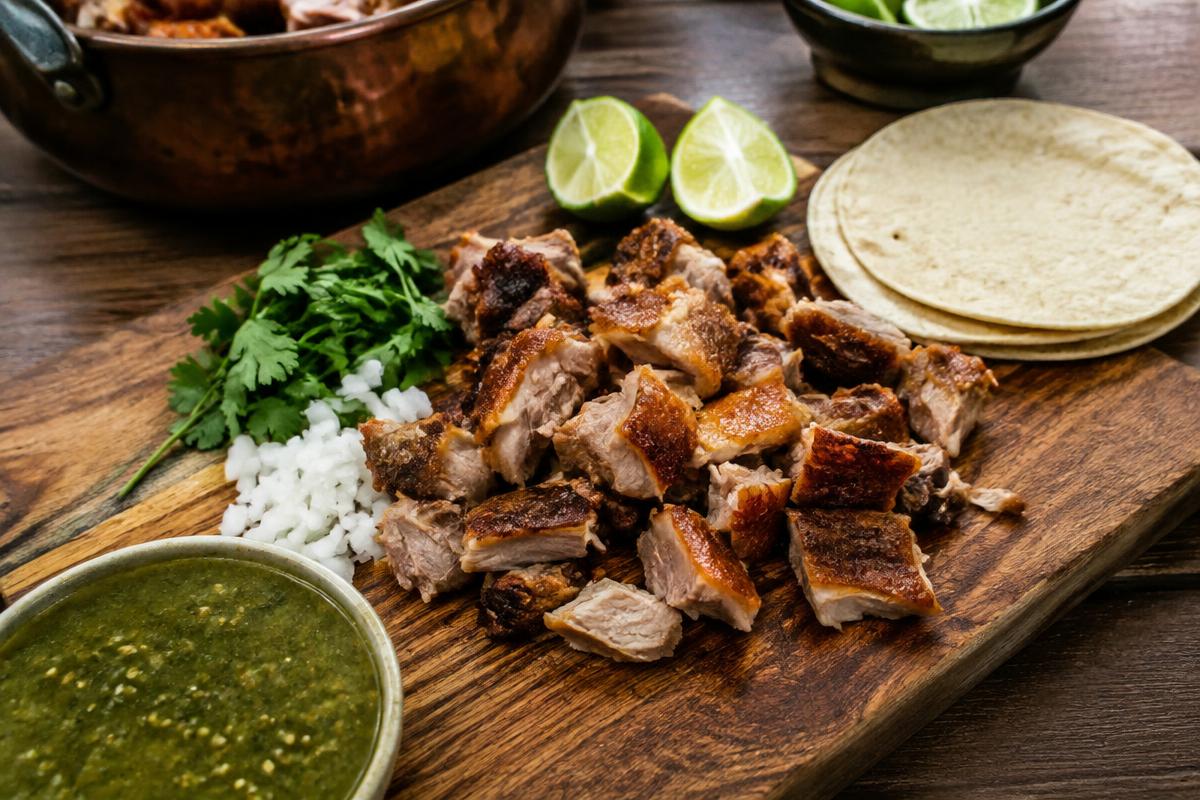
- Using a heavy Mexican cleaver (machete de carnicero), roughly chop the meat into a combination of bite-sized shreds, tender cubes, and crispy crackling shards. Do not shred into uniform strings with forks like pulled pork—authentic carnitas must possess a dynamic contrast of juicy, gelatinous meat and crisp, blistered skin.
Crucial Kitchen Errors & The Troubleshooting Matrix
| Problem | Root Culinary Cause | Immediate Kitchen Remedy | Preventive Action for Future Batches |
|---|---|---|---|
| Meat is dry, chalky, and stringy | Fat temperature was too high during Phase 2 (>230°F / 110°C), boiling muscle fibers instead of confiting. | Shred finely and toss with 3 tablespoons of hot, salted lard and fresh lime juice to re-coat fibers. | Use a probe thermometer. Maintain 200°F–215°F throughout the first 2.5 hours. |
| Meat is pale and soggy with no crisp crust | Insufficient heat in Phase 4, or meat removed before all water evaporated from the lard. | Spread chopped carnitas onto a baking sheet and broil on HIGH for 3–4 minutes until blistered. | Ensure evaporated milk/sugars are added and heat is raised to 350°F until sizzling subsides into clean frying. |
| Pork fell apart into mush in the lard | Pork cubes were cut too small (<1.5 inches) or stirred too aggressively during confit. | Use the meat for carnitas tortas ahogadas or tamale filling. | Cut pork into large 2.5- to 3-inch chunks; turn gently with a flat wooden paddle only twice per hour. |
| Lard burns or tastes acrid | Cinnamon or garlic charred on the bottom of the pot during high-heat crisping. | Immediately pull meat from fat and drain on paper towels; do not use the residual lard. | Fish out garlic heads, onions, and cinnamon stick with tongs before raising heat to 350°F. |
The Authentic Service Protocol
To serve carnitas as they do in Michoacán:
- The Tortilla: Fresh, thick, stone-ground corn tortillas warmed on a screaming-hot dry comal until puffed.
- The Acid Balance: Diced white onion, fresh cilantro leaves, and Mexican Key lime (limón criollo) wedges.
- The Salsa: A vibrant, raw tomatillo-avocado salsa (salsa de aguacate cruda) made with serrano chiles, cilantro, raw tomatillos, and ripe Haas avocado mashed in a molcajete. The high malic and citric acidity of raw tomatillo cuts the dense richness of the lard-confit pork.